
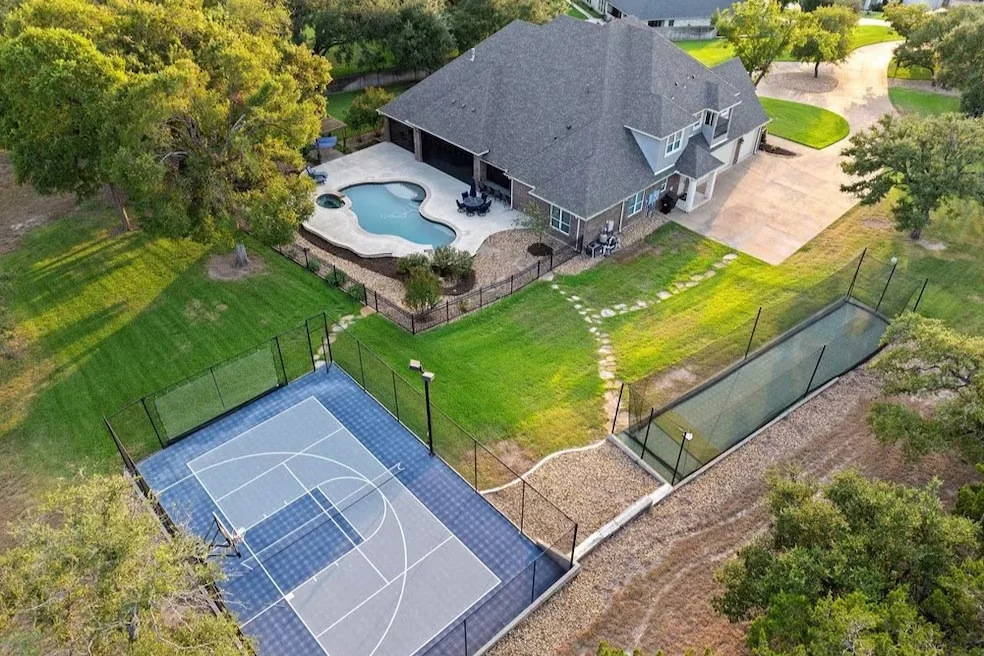
A backyard sport court in Edmonton usually starts around $4,000 for a small driveway hoop pad and runs past $30,000 for a full pickleball court, before any surfacing or hoops. Most of that is the concrete slab underneath.
Here’s the part nobody tells you first: the size you want is usually bigger than your yard is allowed to hold. So let’s start there, then get to the money.
What a Sport Court Costs in Edmonton
The slab is priced by the square foot, the same as any other flatwork. A basic four-inch pad with a broom finish runs $10 to $15 per square foot in the Edmonton area, and you can check the current rates on our concrete cost calculator.
Multiply that out and the picture gets clear fast:
| What you’re building | Slab size | Area | Slab cost at $10–$15/sq ft |
|---|---|---|---|
| Driveway hoop pad | 20 x 20 ft | 400 sq ft | $4,000 – $6,000 |
| Compact play pad | 30 x 30 ft | 900 sq ft | $9,000 – $13,500 |
| Pickleball, minimum total area | 30 x 60 ft | 1,800 sq ft | $18,000 – $27,000 |
| Pickleball, preferred total area | 34 x 64 ft | 2,176 sq ft | $21,760 – $32,640 |
| Basketball 3×3 footprint | 18 x 14 m | 2,713 sq ft | $27,130 – $40,690 |
Three things move those numbers:
- Thickness. A court takes more abuse than a patio, so most go thicker than four inches. Going from a four-inch to a six-inch slab adds roughly 50% to the material cost. Not 50% to the whole job, but it’s real money on 1,800 square feet.
- Site work. A flat, accessible back yard is cheap to prep. A sloped yard, a tight side gate, or a spot where the ready-mix truck can’t reach adds cost before a single yard of concrete is placed.
- Season. Pouring in an Edmonton winter costs 10–20% more because of the heating, blankets and extra time. That premium is real and it’s the reason court quotes come in lower in June than in November.
The surfacing on top — tiles, a colour coating, lines, nets and hoops — is a separate budget from the concrete. Price it separately, and price it after you know the slab is right.
How Big a Court Can Your Edmonton Lot Actually Hold?
This is where most backyard court plans quietly die, and it has nothing to do with money.
Edmonton’s Zoning Bylaw sets a minimum soft landscaped area of 30% of your total lot area for single detached, duplex and semi-detached housing in the RS and RSF zones, under Section 5.60. In the RSM zone that minimum is 25%. Soft landscaping means grass, garden, planting beds — not concrete, not pavers, not a court.
So work it backwards on a 6,000 square foot lot:
| Area | |
|---|---|
| Total lot | 6,000 sq ft |
| Must stay soft landscaped (30%) | 1,800 sq ft |
| Everything else — house, garage, driveway, walks, patio, court | 4,200 sq ft |
Now drop a court into that remaining 4,200 square feet, remembering your house and driveway are already sitting in it:
- A 20 x 20 driveway hoop pad takes 6.7% of the lot. Easy.
- A 30 x 30 play pad takes 15%. Usually workable.
- A minimum-size pickleball court takes 30% of the whole lot on its own. Tight.
- A preferred-size pickleball court takes 36%. On most city lots, no.
- A 3×3 basketball footprint takes 45%. Not happening on a standard lot.
None of this means you can’t build. It means measure your lot and do this subtraction before you fall in love with a size. And check your own zone, because the number that applies to you depends on it. A development permit conversation is cheaper before the design than after.
The Sizes Worth Knowing
If you’re going to scale down, scale down on purpose. Here’s what the governing bodies actually specify.
Pickleball. USA Pickleball’s outdoor court construction guidance puts the playing lines at 20 x 44 ft, with a minimum recommended total playing surface of 30 x 60 ft and a preferred 34 x 64 ft. The gap between the lines and the total is run-off room. You can pour just the 20 x 44 and play on it, but you’ll be stepping off the edge chasing balls.
Basketball. The FIBA Venue Guide gives the 3×3 court a footprint of 18 m x 14 m, and a full-sized court needs the official playing dimensions plus a 2.0 m outer boundary all around. A full court with its run-off does not fit on a residential Edmonton lot. Assume half-court or 3×3 from the start. FIBA also sets a hard minimum of 1.0 m from the pole supporting the backstop to the endline — worth knowing before you pick where the hoop goes, because that clearance comes out of your slab.
Multi-sport. One pad can carry basketball, pickleball, volleyball and badminton lines. If that’s the plan, size the slab to the largest sport on your list and paint the rest inside it.
The Slab Is the Part You Can’t Redo
You can re-coat a surface. You can replace tiles. You cannot fix a slab that was poured wrong without tearing it out, and on a court that means starting over.
Two numbers decide whether a court plays properly.
Slope. FIBA allows a slight slope of up to 1% across a single plane where surface drainage isn’t otherwise possible. One percent sounds like nothing until you run it across a court: over a 60-foot pickleball pad that’s 7.2 inches of fall from one end to the other. Over the 59-foot length of a 3×3 footprint, about 7.1 inches. That water has to go somewhere sensible — not toward your basement, not onto the neighbour’s yard. Plan it with the rest of your yard drainage, not as an afterthought.
Flatness. This is the one people miss. FIBA’s standard for an impermeable surface is that undulations under a 3 m straight edge do not exceed 5 mm across the whole playing area. That’s a deviation of about 0.17%.
Read those two together, because they’re not in conflict and it matters that you understand why. The slope is the whole slab tilted in one flat plane. The flatness is how much the surface is allowed to wander within that plane. You’re allowed to tip the court. You’re not allowed to make it wavy. A slab that dips and rolls will pond water in the low spots and kill the bounce in them, and no amount of coating fixes that later.
That’s a finishing-crew problem, and it’s the single best reason not to shop a court slab on price alone.
Cracks, Joints and Edmonton Winters
Concrete moves. A slab this big will have control joints cut into it so it cracks where you chose rather than where it wants to.
On a sport court those joints matter more than usual, because a joint running through your key is a joint a ball can catch on. This is a design decision to make before the pour: where the joints land relative to the lines, and whether a modular tile surface will sit over top of them and bridge them.
Do not assume you can patch your way out of it later. USA Pickleball is blunt about crack repair on courts: “Coatings alone will not fill cracks,” and “None of the crack repair systems work 100% of the time.”
Then there’s our climate. Edmonton gives concrete a long, cold winter and a lot of freeze-thaw cycling, and a slab sitting on ground that heaves will move with it. The defences are the unglamorous ones — proper base preparation and compaction, real drainage so water isn’t sitting under the slab, and keeping the surface sealed. Our notes on preventing winter concrete damage and on foundation depth in Edmonton cover how that works on other flatwork, and a court is no different — just bigger and less forgiving.
If you already have a slab you’re hoping to reuse, get it looked at honestly first. Sometimes crack repair buys you years. Sometimes it’s throwing good surfacing money at bad concrete.
What the Timeline Looks Like
A court is not a weekend. Roughly:
| Stage | What happens |
|---|---|
| Design and permits | Confirm your zone, soft landscaping math and court size |
| Excavation and base | Dig, place and compact base material, set drainage |
| Forming and pour | Forms, reinforcement, pour, finish to the flatness you’re paying for |
| Curing | The slab needs time before it carries anything |
| Surfacing | Tiles or coating, then lines |
| Equipment | Hoops, nets, fencing, lighting |
Book it for the warm months if you can. You’ll skip the winter premium and the concrete gets an easier start.
FAQ
How much does a backyard sport court cost in Edmonton? The concrete slab runs about $10 to $15 per square foot for a basic four-inch pad, so roughly $4,000 to $6,000 for a 20 x 20 driveway hoop pad and $18,000 to $27,000 for a minimum-size 30 x 60 ft pickleball pad. Surfacing, lines and equipment are extra.
What size is a pickleball court? The playing lines are 20 x 44 ft. USA Pickleball recommends a minimum total playing surface of 30 x 60 ft and prefers 34 x 64 ft, to give players run-off room outside the lines.
Can I fit a full basketball court in my Edmonton back yard? Almost certainly not. A full court needs the official playing dimensions plus a 2.0 m outer boundary, and the smaller 3×3 footprint alone is 18 x 14 m — about 45% of a 6,000 square foot lot. Half-court or 3×3 is the realistic target.
Do I need a permit for a backyard sport court in Edmonton? Talk to the City before you design it. The Zoning Bylaw requires a minimum soft landscaped area of 30% of the lot in the RS and RSF zones and 25% in RSM, and a large slab can push you past that limit. The requirement that applies depends on your zone.
How thick should a sport court slab be? Thicker than a patio. Many courts go to six inches rather than four, which adds roughly 50% to the material cost. The right answer depends on your base, your soil and what the court will carry.
Will the control joints affect play? They can, which is why joint layout is decided before the pour rather than after. Joints get placed with the court lines in mind, and a modular tile surface laid over the slab can bridge them.
Is concrete or asphalt better for a court? Both work as a base. Concrete holds flatness better over time, which is the property a court actually lives or dies on.
Ready to Price Yours?
Send us your lot dimensions and the sport you care most about. We’ll tell you what size fits, what the soft landscaping rule leaves you, and what the slab costs — before you spend anything on surfacing.
See our sport court construction page, or start with the numbers on concrete pads in Edmonton.
