
Planning an addition on your home in Riverbend or a new commercial build in the Warehouse District? Understanding how thick your concrete foundations need to be is the first step toward a project that lasts. It’s not just about pouring a slab; Edmonton’s unique soil conditions and climate demand a careful approach. Here’s what you actually need to know to ensure your investment stands solid for decades.
The team at EdmontonConcrete has seen too many failures from cutting corners on foundation thickness. Getting this right protects your home from cracking, shifting, and costly repairs down the line.

Recommended Thickness for Concrete Slabs and Foundations
While there are minimum code requirements, recommended thickness is what truly protects your project from Edmonton’s realities. These guidelines go beyond the bare minimum to account for real-world use and long-term durability. Think of them as the smart, experienced standard.
Minimum Thickness for Foot Traffic, Patios, and Sidewalks (100 mm or 4 inches)
For surfaces that only need to handle people walking, a 4-inch (100 mm) slab is the standard baseline. This applies to garden paths, simple backyard patios, and most public sidewalks. The load is relatively light and evenly distributed.
Even at this thickness, the subgrade must be properly compacted. A patio in Old Strathcona built on soft, uncompacted fill will crack even with a 4-inch slab. Bottom line: for foot traffic alone, 100 mm is your starting point, but never skip the prep work.
Thickness for Residential Driveways and Light Vehicles (100-125 mm or 4-5 inches)
Your driveway bears a heavier burden. A typical sedan weighs between 1.5 and 2 tons, concentrated on four small tire contact patches. For a standard two-car driveway in a neighbourhood like Glenora, a 4-inch slab is the absolute minimum, but 5 inches (125 mm) is the smart choice.
The extra inch provides a significant margin of safety against the freeze-thaw cycle and the occasional heavier delivery truck. Many reputable contractors, including EdmontonConcrete, default to 5 inches for residential driveways to ensure longevity.
Thickness for Trucks, RVs, and Heavy Loads (150 mm or 6 inches+)
Planning to park a work truck, RV, or boat? You’re now in the realm of heavy point loads. These vehicles can easily weigh 3 tons or more, putting immense stress on a thinner slab.
For these applications, a minimum of 6 inches (150 mm) is non-negotiable. In some cases, especially for commercial loading bays or areas with constant heavy traffic, engineering may call for 8 inches or more. This is a common consideration for properties along the industrial corridors near the Yellowhead Trail.
Footing Thickness Requirements (100 mm or Greater than Projection)
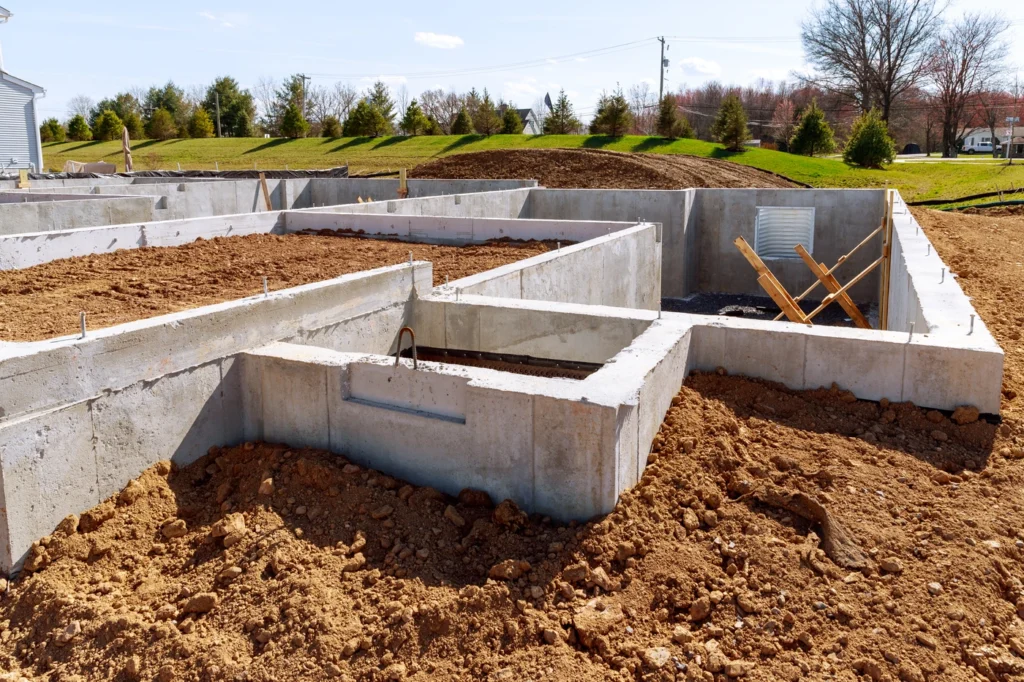
Footings are different from slabs. They are the wide, buried base that spreads the building’s load over the soil. The rule of thumb for footing thickness is that it must be at least as thick as the wall it supports projects outward from its center.
For a standard 8-inch thick foundation wall, the footing must be at least 8 inches thick. More importantly, the Canadian Building Code specifies that the footing thickness must not be less than 100 mm. In practice, residential footings in Edmonton are typically 8 to 12 inches thick to handle our soil conditions.

Alberta Building Code and Local Regulations in Edmonton
Following the Alberta Building Code (ABC) isn’t just good practice—it’s the law. The code provides the minimum legal standards for safety and durability. Edmonton-specific bylaws and the realities of our climate often push practical requirements beyond these minimums.
Minimum Footing Thickness per Clause 9.15.3.8.(1)
The ABC is very specific. Clause 9.15.3.8.(1) states that the thickness of a concrete footing must not be less than the greater of 100 mm or the projection of the footing on either side of the supported wall, column, or pier. This is the technical basis for the “thickness equals projection” rule.
This clause exists to prevent the footing from shearing or bending under load. It’s a critical calculation that forms the basis of all engineered foundation designs for homes and buildings across Alberta.
Structural Analysis and Engineering Requirements
For most standard single-family homes, builders use prescriptive code guidelines. However, when you have unusual soil, a steep slope, or a uniquely heavy structure, a structural analysis is required. A professional engineer will calculate the exact loads and specify footing dimensions and reinforcement.
This is common for custom homes in ravine areas like Terwillegar Towne or for any commercial project. The engineer’s stamp on the drawings is your assurance that the foundation is designed for the specific conditions of your site.
Site Preparation and Subgrade
No matter how thick you pour your concrete, it will fail if the ground beneath it is unstable. Proper site preparation is arguably more important than the pour itself. This is where many DIY projects in Edmonton go wrong.
Removing Vegetation, Dirt, and Soft Spots
All organic material like grass, roots, and topsoil must be excavated down to stable, undisturbed mineral soil. Organic matter decomposes over time, leaving voids that cause settlement and cracking. Any soft, wet, or spongy areas must also be dug out and replaced with compactable material.
Think of it as setting a table. You wouldn’t place a fine china plate on a wobbly, lumpy tablecloth. The same principle applies to your $15,000 concrete slab.
Granular Base and Compaction (20-25 mm Material)
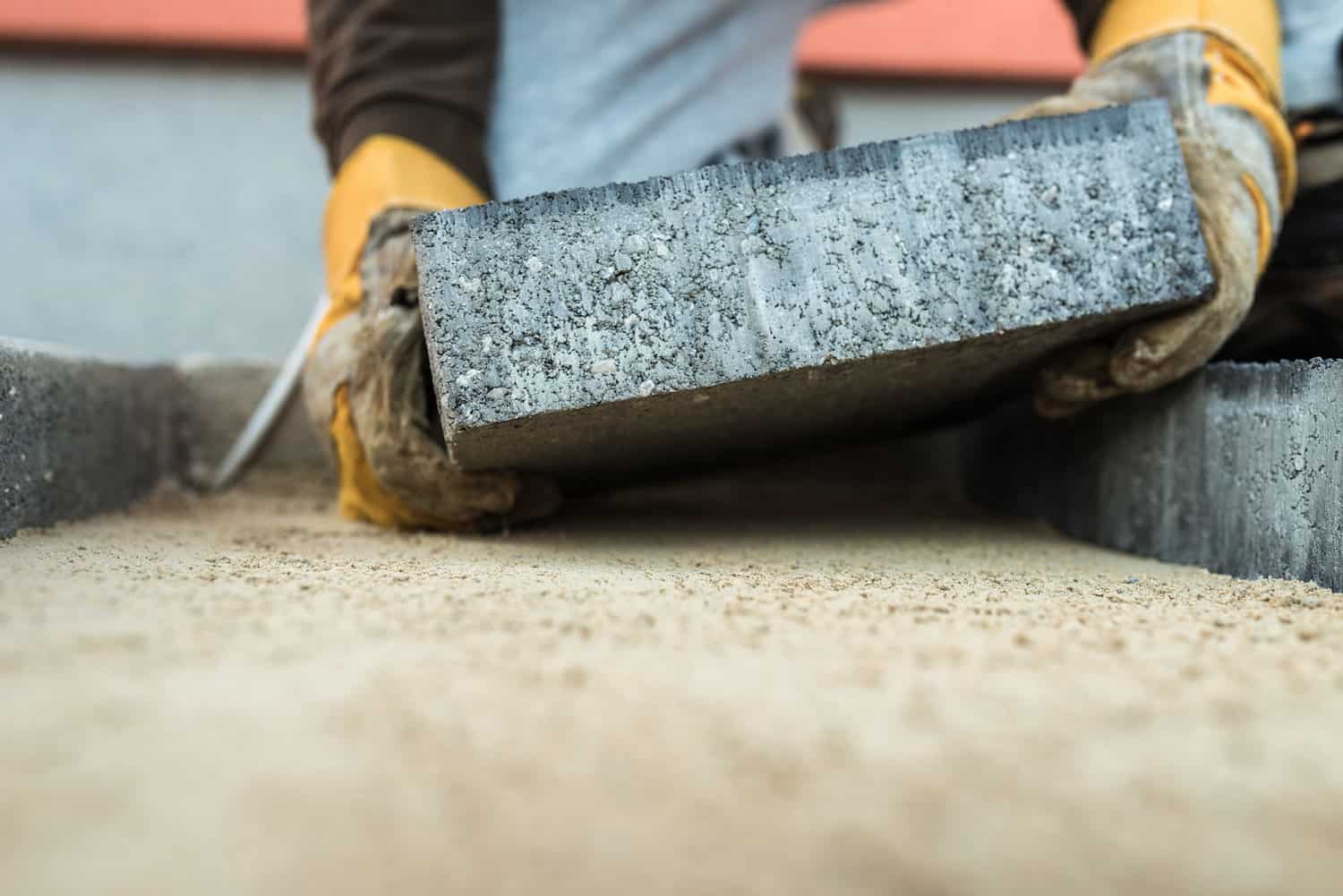
Once you reach stable ground, you add a layer of granular base material. In Edmonton, this is typically 3/4-inch down to 1-inch (20-25 mm) crushed gravel or road crush. This layer provides a stable, draining platform.
The key word is compaction. Each 4-6 inch layer of gravel must be mechanically compacted with a plate compactor or a jumping jack tamper. Properly compacted base won’t show footprints when you walk on it. Skipping this step is an invitation for the slab to sink and crack.
Reinforcement and Concrete Mix Specifications
Reinforcement is what turns brittle concrete into a strong, ductile structural element. It holds the concrete together as it shrinks and resists tensile forces that concrete alone cannot handle.
Rebar Placement (Every 45-60 cm, 60 mm Cover)
Steel rebar is the most common reinforcement for footings and thicker slabs. It’s placed in a grid pattern, typically with bars spaced 18 to 24 inches (45-60 cm) apart, both ways. The rebar must be supported on chairs to keep it positioned in the middle of the concrete thickness.
A critical detail is “cover”—the distance from the edge of the concrete to the rebar. A minimum of 60 mm of cover is required to protect the steel from corrosion. If the rebar is too close to the surface, rust will stain and eventually crack the concrete.
Welded Wire Mesh or Fibers
For thinner slabs like patios and driveways, welded wire mesh (WWF) is often used instead of rebar. It comes in rolls or sheets and is laid over the compacted base. Synthetic or steel fibers can also be added directly to the concrete mix at the plant.
Fibers help control plastic shrinkage cracking as the concrete cures. They are a popular supplement, especially for exterior slabs exposed to Edmonton’s sun and wind during placement.
Concrete Strength (32 MPa, 0.45 w/cm Ratio, Air Entrainment)
The concrete mix itself is specified by its compressive strength, measured in Megapascals (MPa). For foundations and exterior slabs in Edmonton, a 32 MPa mix is standard. Equally important is the water-cementitious materials ratio (w/cm), which should be 0.45 or lower for durability.
Air entrainment is non-negotiable in our climate. Microscopic air bubbles are intentionally added to the mix. These tiny voids give expanding frozen water a place to go, preventing the surface from scaling and spalling after repeated freeze-thaw cycles.

Footing Dimensions and Soil Considerations
Footings translate your building’s weight into a load the soil can safely bear. Their width and depth are just as critical as their thickness. Edmonton’s variable soil, from heavy clay to sand, makes this a site-specific calculation.
Footing Width Based on Soil Bearing Capacity
The width of a footing is determined by the soil’s bearing capacity—measured in kilopascals (kPa). Soft clay might have a capacity of 50 kPa, while dense gravel can be 300 kPa or more. The weaker the soil, the wider the footing needs to be to spread the load.
A structural engineer or geotechnical report will provide this number. For a typical two-story house on average soil in Edmonton, footing widths often range from 16 to 24 inches.
Footing Depth and Frost Line
This is a huge factor in Edmonton. Footings must extend below the frost line to prevent frost heave—where frozen soil pushes the footing upward. In the Edmonton area, the frost line depth is a minimum of 1.2 metres (about 4 feet) below grade.
Building inspectors will check this measurement before the pour. A footing that’s too shallow is one of the most serious and expensive foundation mistakes you can make.
Thickness Range (8-12 inches for Footings)
Given the projection rule and the need for robust construction, residential footing thickness in Edmonton typically falls between 8 and 12 inches. An 8-inch thick wall usually sits on an 8-inch thick footing that is 16-24 inches wide.
For taller structures or poorer soil, the thickness increases. The takeaway: footing thickness is a function of the load above and the soil below, not a one-size-fits-all number.
Forms, Placement, and Best Practices
The final stage is turning plans into reality. Proper forming, pouring, and finishing are where theory meets practice. Even a perfect design can be ruined by poor execution on site.
Oiling Forms and Spacing
Wooden or metal forms that hold the wet concrete must be coated with a release agent (form oil). This allows for clean stripping later without damaging the concrete surface. Forms must be braced and staked securely to resist the immense fluid pressure of the concrete.
They must also be perfectly level and aligned. The time spent checking and re-checking formwork is some of the most valuable time on any concrete project.
Consistent Grade and Slump (80+/-30 mm)
“Grade” refers to the elevation and slope of the finished slab. It must be precise for drainage and meeting other building elements. “Slump” is a measure of the concrete’s workability and water content, tested on-site with a simple cone test.
A target slump of 80 mm, plus or minus 30 mm, is common for foundations. Too high a slump (too wet) means weaker concrete and potential segregation. Too low (too dry) makes it unworkable and hard to place properly.
FAQs: Your Edmonton Foundation Questions Answered
You’ve got the overview, but specific questions always come up. Here are the answers Edmonton homeowners and builders ask most about foundation thickness.
Can I pour a 4-inch slab for a garage floor in Edmonton?
You can, but you shouldn’t. While a 4-inch slab meets minimum code for light traffic, garage floors endure more abuse. Cars drip fluids, you drop tools, and you might even work on the car.
A 5-inch or 6-inch slab with a good mix and proper reinforcement is the standard for a reason. The small extra cost upfront prevents cracked floors and costly mudjacking repairs later, especially with our ground freeze-thaw cycles.
How does Edmonton’s clay soil affect foundation thickness?
Edmonton’s prevalent clay soil is expansive—it shrinks when dry and swells when wet. This constant movement places tremendous stress on foundations. While it doesn’t directly change the *thickness* of the concrete itself, it profoundly impacts footing *width* and *depth*.
Wider footings spread the load over more area to compensate for clay’s lower bearing capacity. Deep footings must extend well below the active clay layer to find stable soil. A geotechnical engineer’s report is money well spent for any significant project.
Do I need a permit for a concrete patio or driveway?
In most cases within Edmonton city limits, yes, you do. Any new impermeable surface over a certain size (often 10 square metres) requires a permit to ensure proper drainage away from foundations and compliance with bylaws.
The permit process also triggers an inspection, which is your best protection against subpar work. The inspector will check the excavation depth, base compaction, and forms before the pour. It’s a hassle that provides essential oversight.
What’s the cost difference between a 4-inch and 6-inch slab?
The cost difference isn’t linear. While you’re using 50% more concrete, concrete is only one part of the total cost. Excavation, forming, reinforcement, and labour are similar.
As a rough estimate, moving from a 4-inch to a 6-inch slab might increase your total project cost by 15-25%. For a standard double driveway, that could mean an extra $1,000 to $2,000. It’s a significant premium, but it buys decades of extra service life and peace of mind.
Conclusion
Determining how thick your concrete foundations should be in Edmonton isn’t about guessing. It’s a science that blends building code minimums, soil mechanics, structural engineering, and harsh local climate realities. From a simple 4-inch sidewalk in Westmount to a heavy-duty 8-inch footing for a commercial build, the right thickness is your first line of defense.
Remember, the concrete itself is only as good as what’s underneath it and inside it. Proper site prep, a well-compacted base, correct reinforcement, and a quality air-entrained mix are all non-negotiable partners to getting the thickness right.
This might feel overwhelming, but you don’t have to become an expert. Your job is to know the right questions to ask. Now that you know what to look for, the experienced team at EdmontonConcrete is ready to help. We bring local knowledge of Edmonton neighbourhoods from Windermere to Highlands to every pour, ensuring your foundation is built right from the ground up.
