
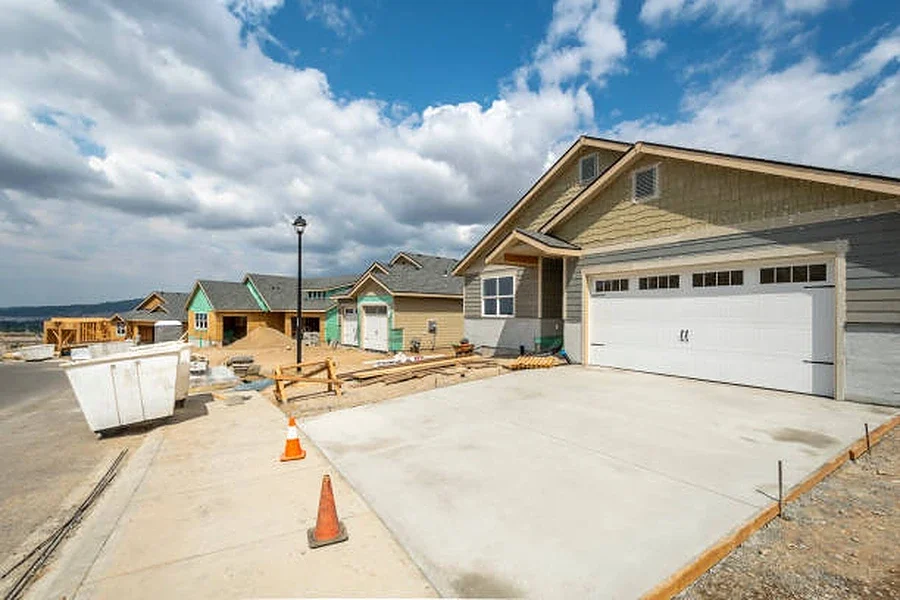
Short answer: yes, you can usually widen a driveway in Edmonton, but there is a hard width limit and you need a permit first. For a single parking space, the widest your driveway can be is 4.3 metres, or the width of your garage, whichever is smaller. Pouring past that, or pouring without the permit, is a violation the City treats as high priority.
That is the whole decision in two sentences. The rest of this page is the detail: where the number comes from, what the permit is called, and when the curb at the street gets involved.
The width limit, in plain numbers
Edmonton’s Zoning Bylaw sets driveway width in Section 5.80, the part that covers parking and access. The limit depends on how many cars park side by side.
| Your situation | Maximum driveway width |
|---|---|
| One parking space | 4.3 m, or the width of your garage or parking area, whichever is less |
| Two or more side-by-side spaces | The width of your garage or parking area, or 3.7 m per side-by-side space, whichever is less |
Two things in that table catch people out.
“Whichever is less” means your garage usually sets the number. A standard single garage is narrower than 4.3 m. If your garage is 3.4 m wide, your driveway limit is 3.4 m, not 4.3 m. The City’s own guidance puts it more loosely: “Generally, the width of your driveway should not exceed the width of your garage.” The bylaw is the precise version of that sentence.
Your sidewalk counts against the limit. This is the one that surprises almost everybody. Under the bylaw, if you have a pathway running parallel to the driveway, the driveway and the pathway are measured together, and the combined width is capped at the same number. So a 3.4 m driveway plus a new 0.9 m walkway beside it is 4.3 m of hard surface being measured as one. If you are planning both, plan them together.
A few more rules from the same section, worth knowing before you draw anything:
- One driveway per house. A maximum of one driveway with street access is permitted for each ground-oriented principal dwelling. A second driveway is not a widening project, it is a different application, and the City lists “the addition of a second driveway or parking area” as a common violation.
- The driveway has to go somewhere. It must lead directly from the street or alley to the garage or parking area. A pad that wanders into the yard is not a driveway.
- Parking spaces off the driveway can’t sit in the front yard. Parking spaces that are not on a driveway must not be in a front yard, a flanking side yard (the side yard along a corner lot’s second street), or a flanking side setback. This is the rule that stops the “just pour a pad beside the driveway for the trailer” plan.
- Hard surfacing is required, not optional. Where vehicle access comes off a street or alley, it has to be hard surfaced. The bylaw does allow driveways and parking areas at houses to be provided as hard-surfaced tire tracks if you prefer that look.
The permit you need is a Home Improvement Permit
The City requires a Home Improvement Permit for all of the following:
- Widening an existing driveway
- Constructing a new driveway
- Replacing an existing driveway with new materials
- Constructing a parking pad in the front or flanking side yard
- Widening a driveway entrance off a public road, which may also require a Curb Crossing Permit
Note the third one. Replacing your driveway with new materials needs a permit even if you are not changing the size. A like-for-like replacement in the same footprint is the usual exception people assume exists, and for a material change it does not.
Applications go through the City’s Self Serve portal. Your contractor or designer can apply on your behalf, and the City encourages using someone experienced, for a practical reason: working without an experienced professional “may significantly increase the application review processing time,” because staff may send plans back for changes.
On timing. The City does not publish a fixed turnaround, and we will not invent one for you. What the City does say is what makes it slower: applications with variance considerations are subject to additional processing times. A variance is the City’s word for permission to depart from a rule. So if your plan fits inside the width limits, you are in the faster lane. If you are asking to exceed them, the review also looks at whether the driveway’s location or width would negatively affect neighbouring properties. Build the schedule around that, not around a hoped-for date.
When the curb at the street gets involved
If widening your driveway also means widening where it meets the road, you are into a second process: a curb crossing.
A curb crossing, also called a curb cut, is the lowered section of curb that lets a vehicle get from the street onto your property. Widening it is not a concrete job you can simply do — the curb is City property, and all vehicle access locations and curb crossings require approval from a Development Planner in consultation with the City’s transportation planning area.
Here is how the City describes the path:
- Get a Curb Crossing Permit. Call 311 for the required documentation, then apply in person at the Edmonton Service Centre or online through Self Serve.
- Once the permit is issued, email the request to the City’s local improvement address.
- The work can go two ways. Through the Local Improvement process, the City does the construction. Or you can have the work done yourself under the permit’s requirements, in which case the Local Improvement process is not needed.
Two financial facts matter more than any estimate:
- You pay all of it. Property owners pay 100% of applicable costs. In the City’s words, “The City does not fund or subsidize this local improvement.” Cost depends on the number of construction locations, market prices, interest rates, and the crossing size required.
- If the City does it, it lands on your tax bill. The Local Improvement assessment is added to the homeowner’s property taxes the year after installation. That is a different cash-flow shape than paying a contractor now, and it is worth knowing before you choose a route.
For shared-title properties such as condominiums, the City mails a Local Improvement Notice to all affected owners, who have 30 days to petition against it. A majority of affected owners must sign to defeat it.
What happens if you skip the permit
We would rather you hear this from us than from an inspector. The City considers hard surfacing violations high priority, and the tools it lists are not warnings:
| Enforcement tool | What it means |
|---|---|
| Stop order | Work halts where it is |
| Municipal and/or violation tickets | Fines issued against the owner |
| Escalating penalty fines | The City publishes a four-figure starting point, escalating from there |
| Caveat on land title | A notice registered against your property, which surfaces when you sell |
| City remediation at owner’s expense | The City can remove the paving and bill you, which it notes “may cost more than the paving itself” |
| Mandatory court appearances | Continuing until compliance is achieved |
The caveat is the one homeowners underestimate. A fine is a bad week. A notice on your title is a problem at closing, years later.
Honest answer: your project may not need any of this
Not every driveway job is a widening job.
If you are replacing a cracked, heaved or spalling driveway in the same footprint with the same material, you are not widening anything, and the width limits are not your issue. If your driveway is already narrower than your garage, you may have real room to widen within the rules and never need a variance. And if what you actually want is a spot for a trailer or an RV, the front-yard parking rule means a pad in the front yard is likely the wrong plan, while a pad off the alley may be straightforward.
Tell us what you are trying to park and where, and we will tell you which of these three you are in before anyone talks about price.
What it costs
We keep pricing in one place so it stays current rather than scattered across articles. Square-foot ranges for driveways, pads and walkways, and the factors that move them, are on our Edmonton concrete pricing page.
What is specific to a widening job is which cost drivers show up: the strip being added is narrow, so edge forming and saw-cutting the existing slab carry more weight per square foot than on a full pour; tying new concrete to old is its own line; and permit and curb-crossing costs sit outside the concrete work entirely.
For the work itself, see concrete driveways in Edmonton, concrete pads and concrete walkways — the last one matters here, because a parallel walkway counts toward the same width cap.
Before you call anyone
Have these four answers ready. They are what decides your project:
- Garage or parking area width. Measure it. It probably sets your limit.
- How many cars park side by side, now and after.
- Whether anything runs parallel to the driveway — an existing or planned walkway.
- Whether the curb at the street has to change. If the entrance stays the same width at the road, you may avoid the curb crossing process entirely.
With those, we can tell you whether your plan fits the bylaw as drawn, whether it needs a variance, and whether a curb crossing is in play — before you commit to a pour. We will come measure on site, and the quote comes after the measurement, not before it.
Outside Edmonton
The bylaw numbers above are Edmonton’s. The surrounding municipalities each set their own driveway width, access and permit rules, and they are not interchangeable with the City’s.
We work in Sherwood Park, St. Albert, Spruce Grove, Leduc, Beaumont, Fort Saskatchewan and Stony Plain. If your property is in one of those, the process is the same shape — confirm the width rule, get the permit, check whether the curb is involved — but the specific numbers come from your own municipality. Ask us and we will point you at the right office before you plan the pour.
FAQ
How wide can my driveway be in Edmonton? For one parking space, 4.3 m or the width of your garage or parking area, whichever is less. For two or more side-by-side spaces, the limit is the garage or parking area width, or 3.7 m per side-by-side space, whichever is less.
Do I need a permit to widen my driveway in Edmonton? Yes. The City requires a Home Improvement Permit to widen an existing driveway, build a new one, replace one with new materials, or build a parking pad in the front or flanking side yard.
Do I need a permit just to replace my driveway? If you are replacing it with new materials, yes — the City lists that as requiring a permit, even without a size change.
Can I add a second driveway? A maximum of one driveway with street access is permitted for each ground-oriented principal dwelling. The City lists adding a second driveway or parking area among its common violations.
Does my walkway count toward the driveway width limit? Yes, if it runs parallel to the driveway. The bylaw caps the combined width of the driveway and parallel pathways at the same maximum.
Can I park on a pad in my front yard? Parking spaces that are not on a driveway must not be located in a front yard, a flanking side yard, or a flanking side setback.
Who pays for a curb crossing in Edmonton? The property owner pays 100% of applicable costs. The City does not fund or subsidize it. If the City does the construction through the Local Improvement process, the assessment is added to your property taxes the year after installation.
What happens if I pour without a permit? The City treats hard surfacing violations as high priority. Tools include stop orders, tickets, escalating penalty fines starting in the four figures, a caveat on your land title, remediation at your expense, and court appearances until compliance.
Sources
- City of Edmonton, Hard Surfacing Driveway Violations: https://www.edmonton.ca/residential_neighbourhoods/hard-surfacing-driveway-violations
- City of Edmonton Zoning Bylaw 20001, Section 5.80 Parking, Access, Site Circulation and Bike Parking: https://zoningbylaw.edmonton.ca/part-5-general-development-regulations/580-parking-access-site-circulation-and-bike-parking
- City of Edmonton, Curb Crossing: https://www.edmonton.ca/transportation/on_your_streets/curb-crossing
- City of Edmonton, Driveway permits: https://www.edmonton.ca/residential_neighbourhoods/driveway-permit
