
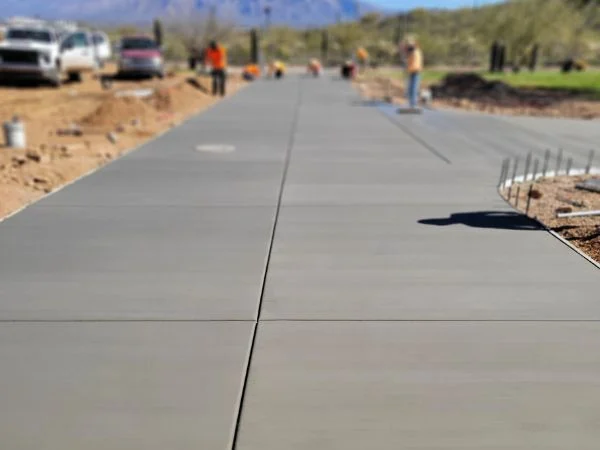
A concrete RV pad in Edmonton usually runs somewhere between $3,000 and $9,000. A 10 by 30 foot pad at four inches thick sits near the bottom of that range. A 12 by 40 foot pad at six inches thick sits near the top.
But the price is the easy part. The harder question, and the one that catches most people, is where the City will actually let the pad go. Edmonton’s rules say that from November 1 to March 31, an RV that isn’t being used has to be stored in the rear yard or inside a garage. That single rule is why most RV pads in this city end up in the back, off the alley, and not on a widened driveway out front.
Here’s the whole picture: what it costs, what size you need, and what to sort out before anyone pours anything.
What does a concrete RV pad cost in Edmonton?
Budget $10 to $15 per square foot for a standard four inch pad with a broom finish, which is the lightly textured, non-slip surface you see on most sidewalks. Heavier pads cost more.
Those are the same square foot numbers behind our Edmonton concrete cost calculator, and they’re the numbers to start from. Multiply your pad’s length by its width, then by the rate.
| Pad size | Square feet | Rough cost at 4 inches |
|---|---|---|
| 10 ft x 25 ft | 250 | $2,500 to $3,750 |
| 10 ft x 30 ft | 300 | $3,000 to $4,500 |
| 12 ft x 35 ft | 420 | $4,200 to $6,300 |
| 12 ft x 40 ft | 480 | $4,800 to $7,200 |
| 14 ft x 45 ft | 630 | $6,300 to $9,450 |
Two things push you up from there.
Thickness is the first. Going from four inches to six inches adds roughly 50% to the material cost of the slab, because you’re buying half again as much concrete. On a 400 square foot pad that’s a real number, and for a heavy fifth wheel or a Class A motorhome it’s money most people decide is worth spending.
Timing is the second. Pouring in cold weather costs about 10% to 20% more than pouring in summer. Edmonton’s pouring season is genuinely short, so a pad booked in July is a cheaper pad than the same one squeezed in during late October.
Then there’s the site. If a truck can’t reach your back yard and the concrete has to be pumped or wheeled in, that’s an added cost, and it’s a common one on older lots in Ritchie, Bonnie Doon or Highlands where the alley is tight.
What size pad do you actually need?
Measure your unit, then add room to walk around it and get the door open.
Start with the length of your RV, not the length you remember from the dealership. Then add about four feet at the back for the hitch or the rear overhang, and give yourself two to three feet on the door side so the awning and the steps land on concrete instead of mud.
| Your RV | Common pad width | Common pad length |
|---|---|---|
| Tent trailer or small utility trailer | 10 ft | 20 to 25 ft |
| Travel trailer, 24 to 28 ft | 10 to 12 ft | 30 to 34 ft |
| Fifth wheel, 32 to 36 ft | 12 ft | 38 to 42 ft |
| Class A motorhome, 36 ft plus | 12 to 14 ft | 42 to 48 ft |
One limit to keep in mind while you plan: in Alberta, the length from the front of the towing vehicle to the rear of the last trailer can’t exceed 20 metres. If your truck and trailer together are near that, the turn into your alley matters more than the pad does. Walk the approach before you commit to a location.
A common money saver here is a two strip pad, sometimes called tire tracks. Instead of one solid slab you pour two concrete runners under the wheels with gravel or grass between them. Edmonton’s Zoning Bylaw allows hard surfaced tire tracks for this kind of residential use, and it can cut the concrete volume nearly in half. The trade off is that you lose the clean, walkable surface around the unit.
Where the City lets you put it
This is the part worth reading twice, because a pad in the wrong spot is an expensive mistake.
In winter, the RV goes in the back. From November 1 to March 31, an RV that isn’t actively being used has to be stored in the rear yard or inside a garage. If your goal is to stop paying for off site storage over the winter, the pad has to be somewhere the bylaw accepts in January.
In summer, the front is limited. Between April 1 and October 31, an RV may be parked in front of a residence that has no back lane, on the driveway only, and it has to sit at least 0.6 metres back from the inside edge of the sidewalk, or 0.6 metres back from the curb if there’s no sidewalk. Outside that window, the Zoning Bylaw generally prohibits parking a large RV in the front yard or flanking side yard beyond what’s needed to load and unload it.
The street is not a storage plan. An RV can sit on the roadway beside your own home for no more than 72 consecutive hours, and then it has to stay off the street for 48 hours before it comes back. Unattached trailers can’t be parked on City streets at any time.
You get one driveway. The Zoning Bylaw allows ground-oriented homes a maximum of one driveway with street access. For a single-car garage, the driveway can be at most 4.3 metres wide, or the width of the garage, whichever is less. So you generally can’t solve this by widening the front driveway into an RV lane.
Keep 30% of the lot soft. Edmonton requires a minimum soft landscaped area equal to 30% of the total lot area in RS and RSF zones, which covers most single, semi-detached and duplex homes. It drops to 25% in the RSM zone. Soft landscaping means grass, garden and planting beds, not concrete. A big rear pad plus a garage plus a driveway can quietly put you over the line, so add it up before you pour.
The fines aren’t small either. Zoning penalties for parking an RV where it isn’t allowed start at $400.
Building a pad that survives Edmonton winters
The pad itself is simple. What goes under it decides how long it lasts.
Our winters are longer and colder than most of the province, and the ground freezes, lifts and settles every year. That movement, called frost heave, is what cracks and tilts slabs over time. You can’t stop it, but you can build so it doesn’t matter much: strip the topsoil, put down a compacted gravel base, and slope the pad so water runs off instead of sitting on it.
Drainage is the piece people skip. Water that pools on a pad or against a foundation is the start of most concrete problems here. The same rules apply as on any flatwork, and we cover them in our guide to concrete drainage in Edmonton.
Two more things worth knowing:
- Keep de-icing salt off a new pad through its first winter. Sand gives you traction without attacking fresh concrete. Our page on winter concrete damage explains why.
- Don’t park the RV on it right away. New concrete needs time before it takes a heavy, concentrated load like trailer jacks or stabilizers. Ask your contractor for a date, and put a pad or plank under each jack foot once you do move on.
Is it worth it against paying for storage?
For most people, yes, if they plan to keep the RV.
Seasonal storage is a recurring bill. A pad is a one time cost that also adds usable, permanent surface to your yard, and it makes loading the unit far easier than hauling everything across town twice a season. The break even point depends on what you’re paying now, but a pad in the $3,000 to $5,000 range typically pays for itself in a handful of seasons against a monthly storage fee.
The case is weaker if your lot is tight, if the alley approach is awkward, or if the 30% soft landscaping rule leaves you no room. In that case a smaller pad for the trailer plus continued storage for the big unit is often the practical answer.
If you’re already planning other work, pouring the RV pad at the same time as a garage pad or driveway is cheaper than doing them separately. One mobilization, one crew, one delivery. Our concrete pads and concrete driveways pages cover how those are priced.
FAQ
How much does a concrete RV pad cost in Edmonton? Most land between $3,000 and $9,000. A four inch pad runs about $10 to $15 per square foot, so a 10 by 30 foot pad is roughly $3,000 to $4,500 and a 12 by 40 foot pad is roughly $4,800 to $7,200.
Can I park my RV in my driveway in Edmonton? Between April 1 and October 31, yes, if your property has no back lane, it’s on the driveway, and it sits at least 0.6 metres back from the sidewalk or curb. From November 1 to March 31, an RV that isn’t being used must be stored in the rear yard or in a garage.
How thick should an RV pad be? Four inches handles light trailers. Six inches is the common choice for fifth wheels and motorhomes, and it adds roughly 50% to the material cost of the slab.
Do I need a permit for an RV pad? Check with the City before you build. A pad on its own is regulated mainly through the Zoning Bylaw, including the one driveway rule, front yard parking limits and the minimum 30% soft landscaping requirement in most residential zones.
Can I park my RV on the street instead? Only briefly. The limit is 72 consecutive hours beside your own residence, followed by 48 hours off the street. Unattached trailers aren’t allowed on City streets at all.
What’s the cheapest way to build one? Two concrete tire tracks instead of a full slab. Edmonton’s Zoning Bylaw permits hard surfaced tire tracks for residential use, and it roughly halves the concrete.
