
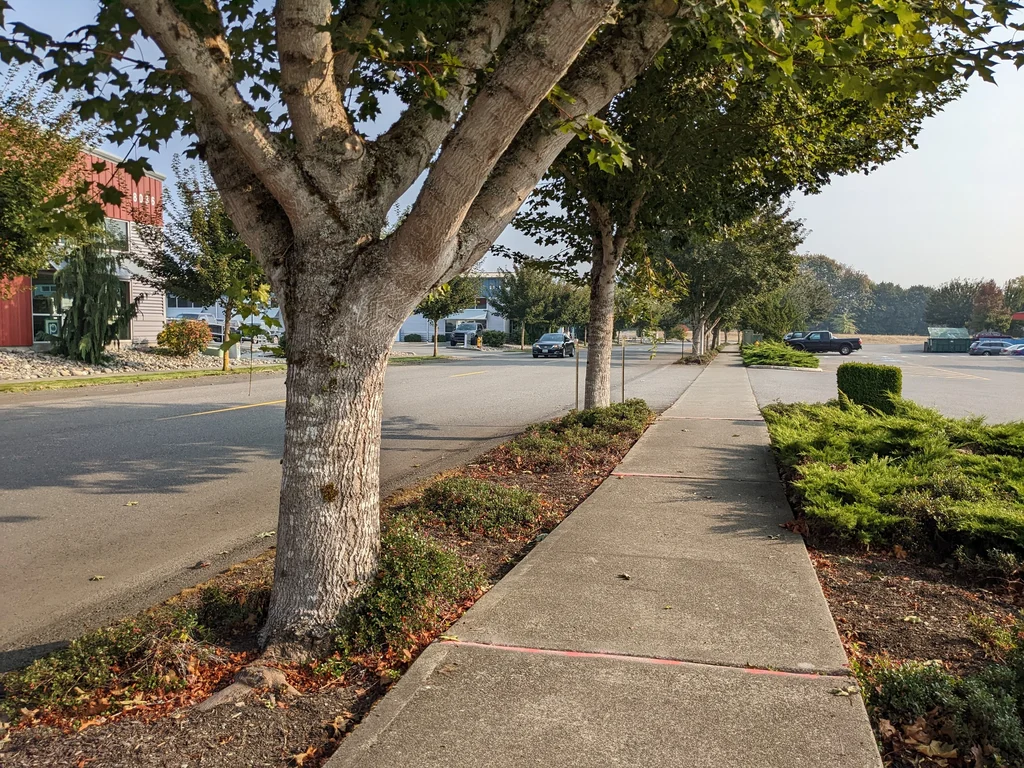
Short answer: if any part of your concrete work happens within five metres of the trunk of a boulevard tree, you need a Public Tree Permit from the City of Edmonton before you start. Budget ten business days for the review. Fines for damaging a City tree start at $1,000.
That is the rule. The rest of this page is what it costs you, and how to plan a walkway, driveway or pad around it without losing a season.
First, that tree is probably not yours
Most Edmonton homeowners assume the grass strip between the sidewalk and the curb is part of their yard. It is not. The City defines it plainly: “A boulevard is the portion of City property between the curb or road’s edge and the adjacent front property line.”
You still have to look after it: “Residents are responsible to care for the boulevard, alley and driveway crossing adjacent to their property line.” So you mow it and rake it. You do not own it, and you do not own the tree standing in it.
One more wrinkle. The City notes that “The location of the property line should be confirmed prior to pruning or removing a tree, as the tree may be City-owned if a portion of the yard is within the Road Right-of-Way.” In older Edmonton neighbourhoods the right-of-way reaches further into the yard than people expect, so a tree that looks like it is on your lawn can still belong to the City.
And on building over the boulevard itself: “Obtain City approval before building structures on any portion of a boulevard.”
When you need a Public Tree Permit
Two distances trigger the permit. From the City’s Public Tree Permit page:
“A Public Tree Permit will be required for any work done within five metres of the trunk of a boulevard and open space tree or within 10 metres of a natural stand boundary.”
Five metres from a trunk is a big circle. On a standard Edmonton front lot it usually reaches the public sidewalk and often a metre or two past it, so a walkway replacement, a widened driveway or a new front pad frequently lands inside it.
Here is what does and does not need the permit.
| Activity | Permit needed? |
|---|---|
| Construction without excavation near the tree | Yes, plus a Tree Protection Plan |
| Demolition without excavation near the tree | Yes, plus a Tree Protection Plan |
| Excavation near the tree | Yes, plus a Tree Preservation Plan prepared or approved by a professional |
| Major grade changes, such as raised beds, planter boxes, re-grading | Yes, plus a Tree Preservation Plan |
| Driving or parking equipment off the pavement near the tree | Yes |
| Storing materials off the pavement near the tree | Yes |
| Mowing, raking, mulching | No |
| Gardening on your own private property | No |
| Vehicular access on roadways, driveways, sidewalks and improved trails | No |
That last exemption is narrower than it sounds. The wording is “paved or granular surface.” Driving over existing hard surface is fine. The moment your bobcat, forms or gravel pile sits on the grass inside the zone, you are in permit territory. And since almost every residential concrete job involves excavation, a close tree usually puts you in the Tree Preservation Plan category, not the lighter one.
The protection zone is sized to the tree
The distance is not always the full five metres. The City scales the minimum protection distance to the size of the trunk, measured as diameter at breast height.
| Trunk diameter (DBH) | Trunk circumference | Minimum protection distance |
|---|---|---|
| 10 cm and under | Under 31 cm | 1.2 m |
| 11 to 30 cm | 34 to 94 cm | 1.8 m |
| 31 to 40 cm | 97 to 125 cm | 2.4 m |
| 41 to 50 cm | 129 to 157 cm | 3.0 m |
| 51 to 60 cm | 160 to 189 cm | 3.6 m |
| 61 to 70 cm | 192 to 220 cm | 4.2 m |
| 71 to 80 cm | 233 to 251 cm | 4.8 m |
| Over 80 cm | Over 251 cm | 5.0 m |
There is a shortcut in those two columns. The permit triggers at five metres regardless of tree size, but the zone you must physically keep clear can be as small as 1.2 metres. That difference decides whether your project changes shape.
So take a tape measure out front before you call anyone. Measure the trunk circumference at chest height, find your row, and you will know which conversation you are having.
What it actually costs you
Good news first. The City’s FAQ page states: “Public Tree Permit application and inspection fees will continue to be waived in 2024.” Waivers are set year by year, so confirm the current position when you apply. The cost lands elsewhere.
Redesign. Our Edmonton concrete price page puts a 4-inch broom-finish slab at $10 to $15 per square foot and a driveway at $12 to $18. Put a dogleg in a 3-foot front walk to clear the zone, adding about 10 feet of length, and that is roughly 30 square feet, or $300 to $450. Narrow a 20-foot driveway to 17 feet over its last 20 feet and you remove about 60 square feet, saving $720 to $1,080 but losing side-by-side parking. Neither is huge money. Both are decisions to make on paper, not on pour day.
The concrete is not the expense. Ready-mix runs about $180 to $250 per cubic yard here, and a 4-inch slab covers about 81 square feet per yard. So that extra 30 square feet is about a third of a yard, roughly $67 to $93 of actual concrete. When a tree forces a more complicated shape, you are paying for formwork and labour, not for mud.
Going thicker instead of deeper. Bridging over roots with a thicker slab beats excavating a deep base, and it costs: 4 inches to 6 inches raises material cost by roughly 50%.
The calendar. This is the one that hurts. Edmonton’s comfortable pour window is short, and winter pours run about 10 to 20% more for heating and protection. A ten-business-day review in early October can be the difference between a September price and a winter one.
Professional sign-off. If you are excavating, the City requires a Tree Preservation Plan “written and/or signed off by” a qualified professional, from a list that includes an “International Society of Arboriculture Certified Arborist,” registered foresters, landscape architects, professional biologists, agrologists and journeyman landscapers. That is an outside fee, and it varies with the site.
The timeline, realistically
The City’s commitment: “If the application meets the requirements, a Public Tree Permit will be issued within 10 business days.” The FAQ repeats it as “reviewed within ten business days by an Urban Forester.”
A second ten-day clock catches people. If the job needs work on the tree itself, such as clearance pruning for machine access, “All maintenance on City trees must be coordinated through a City of Edmonton Urban Forester with at least 10 business days notice.” Those clocks can overlap, but not always.
| Step | Allow |
|---|---|
| Measure the trunk, confirm the zone, get a quote | A few days |
| Arborist or qualified professional prepares the plan, if excavating | Depends on availability |
| Submit the Public Tree Permit application | Same day |
| City review | 10 business days |
| Clearance pruning notice, if any branches are in the way | 10 business days notice |
| Install protection fencing, then excavate and pour | Normal project schedule |
Three weeks before anyone breaks ground is a fair assumption when a mature tree is involved.
What a Tree Protection Plan has to contain
For the lighter, no-excavation case, the City asks for a Tree Protection Plan that includes “A brief project summary,” estimated dates, “Tree protection fencing details,” “Clearance pruning requirements,” and “Anti-compaction measures,” plus site plan documentation.
Anti-compaction matters more than people realise. Roots do not just get cut, they get crushed. A loaded truck or gravel stockpile on the root zone can kill a tree two summers later, long after the slab looks perfect. That is why storing materials inside the zone needs a permit at all.
If the tree gets damaged
Two numbers circulate here, from two different rulebooks. For City-owned trees, the Public Tree Permit page states: “Fines starting at $1000, which bylaw officers may double daily, the province’s Municipal Governance Act allows fines up to $10,000.” The FAQ adds that “The City continues to have the ability to levy fines and/or collect equitable compensation for damage to City-owned trees.” Equitable compensation means the appraised value of the tree, which on a large mature specimen can exceed the fine.
Separately, under the City’s Community Standards Bylaw, which covers the duty to keep your own trees from blocking sidewalks and roads, “The officer may issue a bylaw ticket with a fine ranging from $250 to $10,000 depending on the circumstances.”
So: the $1,000 starting point and daily doubling is the City-tree exposure. The $250 to $10,000 range belongs to the separate private-tree maintenance duty. Do not mix them up when someone quotes a number at you.
Five ways to keep the tree and still get your concrete
- Taper at the tree end only. Keep full width where you need it and narrow near the trunk. The table above tells you how much room you need.
- Hand dig inside the zone. Slower per foot, but it saves roots and keeps machines off the root plate.
- Bridge instead of dig. A thicker slab over a shallower base avoids cutting structural roots, at roughly 50% more material.
- Move the alignment, not the width. A walkway can curve. On most front yards a gentle sweep costs a few hundred dollars and solves the problem outright.
- Book the permit before the quote is final. The review runs in the background while you settle on a finish.
How this differs from lot grading approval
Two City processes can apply to the same front-yard pour, and they are unrelated. Lot grading approval is about water: where it drains once your slab is in, and the surveyed grades the City signs off on. The Public Tree Permit is about a living asset the City owns, measured in metres from a trunk and reviewed by an Urban Forester. Different department, different clock. A project can need both.
Where this comes up most in Edmonton
Mature, tree-lined boulevards are the trigger. Glenora, Highlands, Westmount, Garneau, Ritchie, Bonnie Doon and Alberta Avenue all have large boulevard trees close to the sidewalk. Assume the permit applies until your tape measure says otherwise. Newer areas have younger City trees, where clearance can be as little as 1.2 metres.
One caution for the region: these rules are the City of Edmonton’s. Strathcona County, St. Albert, Spruce Grove, Leduc, Beaumont, Fort Saskatchewan and Stony Plain each run their own tree and boulevard rules. Outside city limits, confirm with that municipality first.
FAQ
Do I need a permit to pour a concrete walkway near a city tree in Edmonton? If any part of the work is within five metres of the trunk, yes. And because most walkway work involves excavation, you will also need a Tree Preservation Plan prepared or approved by a qualified professional.
How long does a Public Tree Permit take in Edmonton? The City issues the permit within 10 business days when the application meets requirements.
How much does a Public Tree Permit cost? The City stated that application and inspection fees would continue to be waived in 2024. Confirm the current year’s position when you apply. The real costs are the preservation plan, fencing, any redesign, and the delay.
Can I just cut the roots that are in my way? No. Cutting roots inside the protection zone without a permit exposes you to fines starting at $1,000, which bylaw officers may double daily, and to a claim for the tree’s value.
What is the difference between a Tree Protection Plan and a Tree Preservation Plan? A Tree Protection Plan covers work without excavation and can be prepared by you. A Tree Preservation Plan is required when excavating and must be written or signed off by a qualified professional such as an ISA Certified Arborist.
Will the permit stop my project? Rarely. It usually changes the shape or the sequence, not the answer. The projects that get into trouble are the ones that started digging first.
Get a firm number on your project
The fastest way to know what the tree does to your budget is to have someone measure it on site with your layout in hand. We will walk the front yard, measure the trunk, mark the protection zone, and tell you whether the shape changes and what that does to the price.
To run the numbers yourself first, start with our Edmonton concrete prices, then the page for the work you are planning: walkways, driveways, patios or pads.
Book the measure early in the season if a mature tree is involved. Three weeks of permit lead time is much cheaper in June than in October.
Sources
- City of Edmonton, Public Tree Permit: https://www.edmonton.ca/residential_neighbourhoods/gardens_lawns_trees/public-tree-permit
- City of Edmonton, Public Tree Permit Frequently Asked Questions: https://www.edmonton.ca/residential_neighbourhoods/gardens_lawns_trees/frequently-asked-questions
- City of Edmonton, Boulevards: https://www.edmonton.ca/city_government/bylaws/boulevards
- City of Edmonton, Tree Regulations: https://www.edmonton.ca/city_government/bylaws/tree-regulations
