
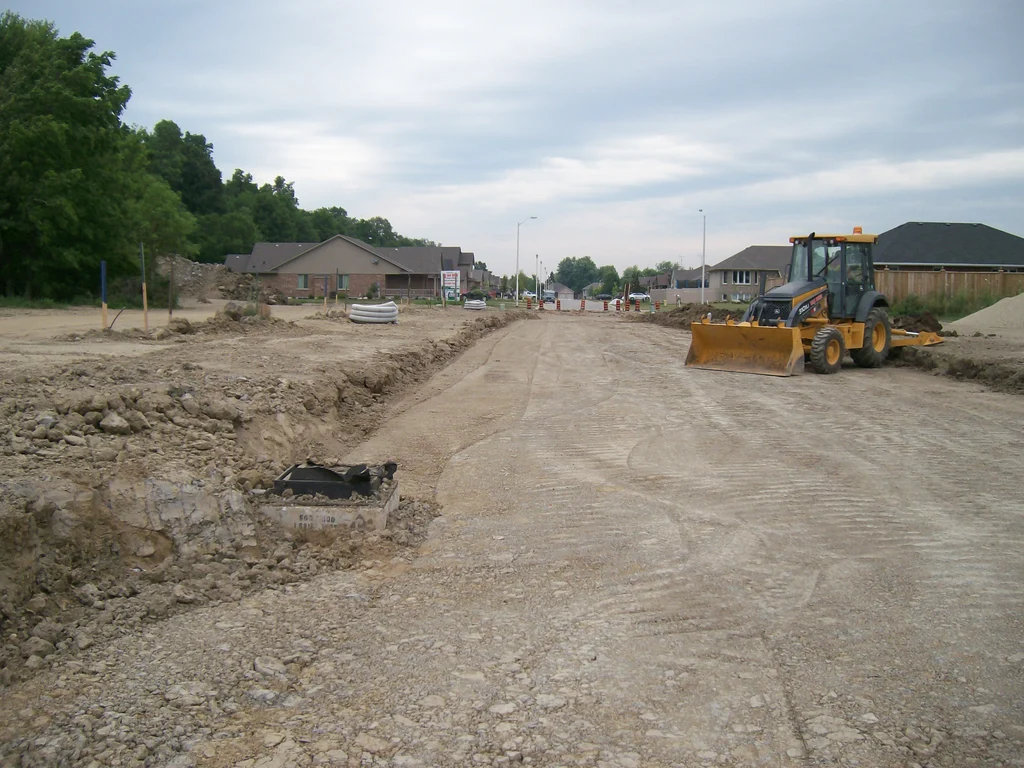
Short answer: you are responsible. Not your builder, not the City, not the neighbour whose downspout you suspect. The City of Edmonton puts it in one line — “Property owners are responsible for their own lot grading.”
Lot grading is the shaping and sloping of your yard so that rain and snowmelt run away from your house and out to the lane or the street. That is the whole idea. The City regulates it because a yard that sends water the wrong way does not just flood one basement. It floods the one next door too.
This page explains what the City actually checks, the deadline that catches people out, and the part most homeowners never hear until it is too late: pouring new concrete can put a yard that already passed back offside.
Who has to deal with this, and when
Three situations bring lot grading to your door.
You have a new or recently built home. New lots need grading approval, and it happens in two stages.
You are redeveloping. The City notes that re-grading or redevelopment can create runoff problems or expose ones that were already there.
You have water where it should not be. Flooding after heavy rain or snowmelt, or slower trouble like foundation settlement, all land in the same place.
Here is the part that surprises people. Drainage Bylaw 18093 took effect January 1, 2018, replacing the older Bylaw 16200, and it applies to every property in the city. In the City’s own words, “the standards are enforced retroactively for all properties” — even though plenty of older Edmonton neighbourhoods never had an approved Lot Grading Plan in the first place. A 1960s bungalow in Hazeldean is held to the same drainage standard as a new build in Laurel.
The two inspections and the 60-day clock
If your lot needs approval, it comes in two passes.
| Stage | What it means |
| Rough grade | The soil is shaped to the design elevations, before topsoil and landscaping |
| Final grade | Topsoil is “smoothly spread out, compacted and ready for sod, liners, rocks, and other materials” |
The process is the same for both.
- The grading work gets done.
- An Alberta Land Surveyor (a licensed professional who measures and certifies land elevations) prepares a Rough or Final Residential Lot Grading Certificate.
- The applicant submits that certificate through the City’s self-serve portal to request an inspection.
- A Lot Grading Inspector compares the lot against the approved Lot Grading Plan, the Lot Grading Requirements, and Drainage Bylaw 18093.
- You get an Inspection Report marked Passed or Failed.
Before the inspector arrives, the site has to be accessible, animals contained, and obstructions cleared. A locked gate or a dog in the yard means a wasted trip and, usually, a re-inspection fee.
If it fails, the report lists the deficiencies by position — left, right, front or back. Front means the side facing the property from the City street. On a corner lot, the front is the shorter of the two property lines along the street.
Then the clock starts. “The applicant must correct the deficiencies within 60 days,” unless the report says something different. Re-inspection is booked online, and you cannot book it if a new certificate is needed or re-inspection fees are outstanding.
The sentence that matters most for concrete
Read this line from the City’s approval page carefully, because it is the one that connects grading to your patio: approval “is based on the site conditions observed at the time of the lot grading inspection.”
A pass is a snapshot. It is not a permanent clearance.
So when you pour a patio two summers later, or widen the driveway, or add a pad for a shed, you are changing the surface the City signed off on. Concrete does not soak up water the way a lawn does. Every square foot of new slab is a square foot that now sheds water somewhere, and where it sheds is entirely up to how the slab is sloped and where its edges sit.
Done properly, this is a non-issue — concrete is actually easier to grade accurately than soil, because it holds the slope you give it instead of settling over a few seasons. Done carelessly, three things go wrong:
- The slab slopes back toward the house. Water sits against the foundation, and in an Edmonton winter it freezes there. Repeated freezing and thawing against a foundation wall is exactly the pressure cycle you do not want.
- The slab blocks a swale. A swale is the shallow dip between two houses that carries water back to the lane. Pour across one at the wrong elevation and you have built a small dam between you and your neighbour.
- The slab dumps water over the property line. The City is blunt that “all property owners have an equal interest in effective drainage of surface water.” Sending yours next door is how a friendly fence line turns into a 311 file.
None of that costs more to avoid at the quoting stage. It costs a great deal to fix after the concrete has cured.
What the City will not do for you
This is worth knowing before you spend a morning on hold. Edmonton’s Lot Grading staff inspect for bylaw compliance and explain requirements. That is the job. Beyond it, the City states plainly that its Lot Grading staff:
- “are not consultants and do not provide solutions”
- “do not have a mandate to resolve disputes”
- “do not respond to urgent surface runoff or drainage issues”
They do not attend during an active storm. If water is coming into your house right now, the City’s own advice is to call a private company — a restoration contractor, a landscaper, a grading contractor, an inspector or a foundation contractor. The City also points homeowners to EPCOR’s free Flood Prevention Home Check-up, while noting that those advisors do not provide lot grading information.
We would rather tell you that up front than let you discover it at 311 on a Saturday.
If the water is coming from next door
The City has a defined path for this, and skipping steps slows it down.
- Talk to your neighbour first. The City leads with this for a practical reason: they often have no idea there is a problem.
- Call 311 to register a complaint if that conversation does not land.
- Fill out the paperwork. Development Services, Lot Grading sends an Information Guide and a Witness Statement Form. Complete it and send it back.
- An inspector examines both properties. Not just theirs — both.
- If Bylaw 18093 is being violated, a Non-Compliance notice is issued and the owner has to bring the property into compliance.
Note step four. If your own grading is part of the problem, the inspection will find that too. It is worth an honest look at your own yard before you file.
What a well-graded concrete job looks like here
You do not need numbers off a drawing to sanity-check a quote. You need a contractor who talks about water before they talk about finishes.
- Every slab slopes away from the house. Patios, walkways, garage pads, all of them.
- Existing swales stay functional. If a slab has to cross one, the drainage gets rebuilt, not buried.
- Edges are set so runoff lands on your lawn or heads to the lane, not over the line.
- Downspouts get extended past the new concrete, not left to discharge onto it.
- Snow has somewhere to go. In this city, a slab is a snow-storage surface for months of the year, and meltwater follows the slope you built in April.
- Window wells near new concrete stay clear and above grade.
On frost: Edmonton ground freezes deep and moves. We describe this qualitatively on purpose, because the depth varies by site, soil and winter. What matters is the consequence — water that collects beside or under a slab is water that will lift it. Grading is the cheapest frost protection there is.
What grading work does to a concrete quote
Grading is a real line item, and it moves for honest reasons: how far off your yard is from where it needs to be, how much soil has to move, whether a swale needs rebuilding, access for equipment, and whether a surveyor’s certificate is part of your situation.
That last one is worth separating out. The certificate comes from an Alberta Land Surveyor, not from us, and not from any concrete contractor. If your project triggers a grading inspection, that is a separate professional engagement, and any contractor who tells you otherwise is guessing.
For the concrete itself, our Edmonton concrete price guide is the fastest way to get your bearings before anyone walks your yard. Then look at the specific job: patios, driveways, pads or walkways.
And an honest note: if your actual problem is drainage rather than concrete, you may not need us at all. A regrading and sod job sometimes fixes what a patio cannot. We will say so on the site visit.
Outside Edmonton
Bylaw 18093 and the inspection process above are City of Edmonton rules. If you are in Sherwood Park, St. Albert, Spruce Grove, Leduc, Beaumont, Fort Saskatchewan or Stony Plain, your municipality has its own grading and drainage requirements, its own forms, and its own deadlines. The physics in your yard is identical — water still runs downhill into whatever is lowest — but do not assume the paperwork matches. Check with your own town or county office before you book anything.
FAQ
Who is responsible for lot grading in Edmonton?
The property owner. The City states that “property owners are responsible for their own lot grading,” and that owners must maintain the grading around the house and across the property.
How long do I have to fix failed lot grading?
Sixty days. The inspection report says “the applicant must correct the deficiencies within 60 days” unless it specifies otherwise. Re-inspection is booked online and cannot proceed if a new certificate is required or re-inspection fees are unpaid.
Does the drainage bylaw apply to an older Edmonton house?
Yes. Drainage Bylaw 18093 took effect January 1, 2018 and applies to all properties, and the City notes the standards “are enforced retroactively for all properties” — including older neighbourhoods that never had an approved Lot Grading Plan.
Can a new patio or driveway break my grading approval?
It can. Approval “is based on the site conditions observed at the time of the lot grading inspection,” so changing the surface afterward changes what was approved. New concrete that slopes toward the house, crosses a swale at the wrong height, or sheds water over the property line can put a previously passing lot offside.
Will the City fix my drainage problem or settle it with my neighbour?
No. The City inspects for bylaw compliance and issues Non-Compliance notices, but its Lot Grading staff “are not consultants and do not provide solutions” and “do not have a mandate to resolve disputes.” They also do not respond to urgent runoff during a storm.
What does a lot grading certificate involve?
An Alberta Land Surveyor measures the completed grading and issues a Rough or Final Residential Lot Grading Certificate. The applicant submits it through the City’s self-serve portal to request an inspection against the approved Lot Grading Plan and the bylaw.
How much ponding is a Lot Grading Plan designed for?
Residential Lot Grading Plans show the major conveyance system, including flow directions, ponding areas and maximum ponding depth for a “1 in 100 year return frequency rainfall event.”
Get a straight answer about your yard
Send us photos of where the water goes and what you are thinking of pouring. We will tell you whether grading is part of your job, whether a surveyor needs to be involved, and what the concrete itself should cost — before anyone asks you for a deposit.
Sources: City of Edmonton — Residential Lot Grading Approval, City of Edmonton — Lot Grading Issues, City of Edmonton — Lot Grading Plan, Residential.
