
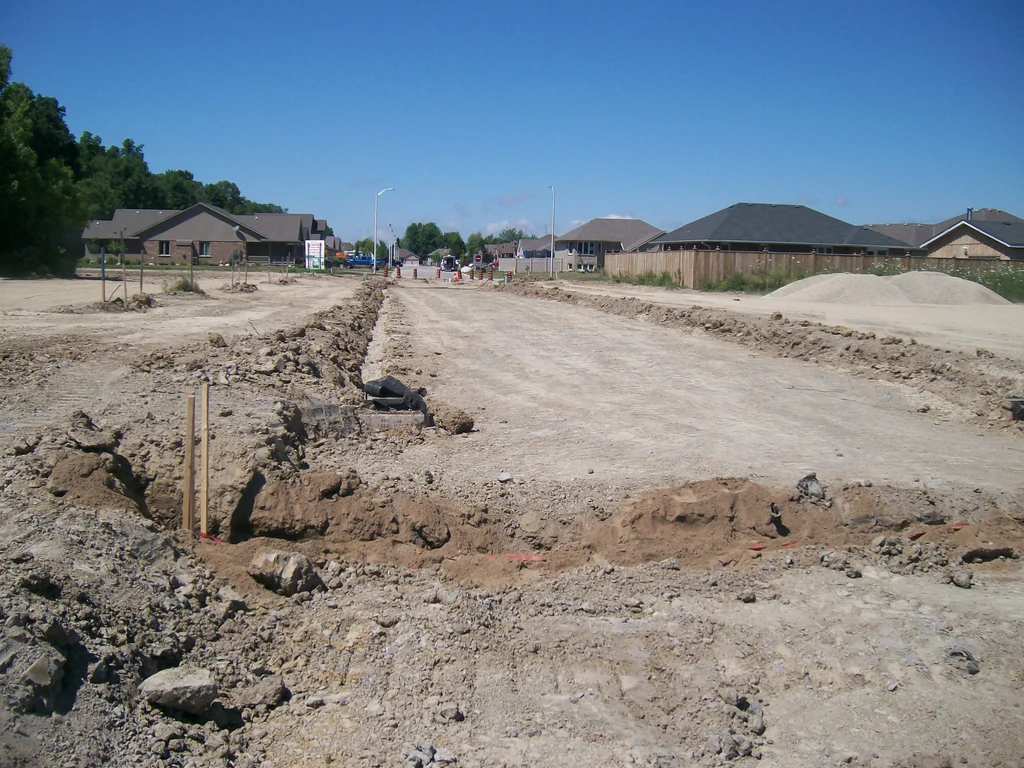
Short answer: pouring a patio or pad does not usually mean you reapply for lot grading approval. But your responsibility for the grading never went away, and the new slab is exactly the kind of change that can break it.
That is the part nobody tells homeowners before the forms go in.
Here is how it actually works in Edmonton, in plain language, with the numbers you can plan around.
What lot grading approval is, in one paragraph
Lot grading is just the shape of the dirt around your house. It is sloped so rain and snowmelt run away from your foundation, into a shallow channel called a swale, and out to the street or back lane rather than into your basement or your neighbour’s.
When a house is built, the City checks that shape twice. There is a rough grade stage, done before landscaping, and a final grade stage after. An Alberta Land Surveyor prepares the certificate, the builder or owner submits it, and an inspector signs off. If something fails, the City’s process gives 60 days to fix the deficiencies unless it says otherwise, and re-inspection fees can apply.
For most people reading this, that already happened years ago. Your lot is approved. So why does it matter now?
Because the obligation is permanent
This is the sentence from the City’s own Lot Grading FAQ that changes how you should plan a slab:
“From that moment on, as the property owner, it is your obligation to maintain the lot grading permanently regardless of natural settlement or activity caused by yourself or damage by a 3rd party.”
Read the middle of it again. Activity caused by yourself. A patio is activity. So is a new walkway, a hot tub pad, a parking pad off the lane, or a shed slab.
You do not have to redo the approval to pour a patio. You do have to keep the lot draining the way the approved grade says it drains. If your new slab blocks the swale or tips water at the house, you are the one on the hook, and nobody from the City is coming to design a fix for you.
The City is blunt about that too. Its Lot Grading Issues page says staff “are not consultants and do not provide solutions,” that they have no mandate to resolve disputes, and that they do not respond to urgent surface runoff issues. It also warns that “re-grading or re-development can create surface runoff issues or highlight existing issues resulting in basement flooding, property damage or disputes between neighbours.”
Translation for a homeowner in Terwillegar, Mill Woods or Sherwood Park: get the slope right the first time, because the do-over is entirely yours.
The three ways a new slab breaks a good grade
| What goes wrong | How it happens | What you notice |
|---|---|---|
| The slab dams the swale | The pad crosses the shallow drainage channel between you and the neighbour | Water sits along one edge after every rain, and stays late into spring |
| The slab slopes the wrong way | The finished surface tips back toward the house instead of away | Puddles against the foundation, damp basement wall, ice by the back door |
| The slab sits too high | New concrete is poured level with a door sill rather than stepped down | Snowmelt runs across the slab and into the house instead of off it |
All three are avoidable at the layout stage and expensive afterward. A slab that dams a swale usually has to come out. There is no sealing your way around a grade problem.
The number to hold your contractor to is on the City’s own FAQ: “Ensure that you have 5% slope away from all the foundation walls,” and keep the slope along swales “smooth and consistent.” Five percent is roughly a 100 mm drop over 2 m, which is more fall than most people picture. Flatwork against the house should shed water visibly, not subtly.
The bylaw limit most people miss
Before you decide how big the patio should be, check how much of your yard is already hard surface.
Edmonton’s Zoning Bylaw sets a minimum for Soft Landscaping, which it defines as “Landscape materials that allow water infiltration and absorption into the ground to reduce stormwater runoff and to be capable of supporting living plants.” Concrete does not qualify. Neither do decking, bricks or pavers.
| Zone | Minimum soft landscaped area |
|---|---|
| RS and RSF | 30% of the total lot area (subsection 3.2.1) |
| RSM | 25% of the total lot area (subsection 3.3.1) |
There are planting minimums attached to the same section, set by how wide your site is: 1 tree and 4 shrubs under 8.0 m, 2 trees and 6 shrubs from 8.0 m to 15.0 m, and 4 trees and 8 shrubs over 15.0 m.
On a standard infill lot, that 30% adds up faster than it sounds once you count the house footprint, the driveway, the existing walk and the garage pad. Run the math before you fall in love with a patio size. It is far cheaper than redesigning after a development officer asks the question.
What the concrete itself costs
Use these as planning numbers, then get a site-specific quote. Our Edmonton concrete cost calculator carries the full breakdown.
| Work | Planning range |
|---|---|
| Plain 4 inch slab, broom finish | $10 to $15 per square foot |
| Concrete work generally | $10 to $25 per square foot |
| Driveway | $12 to $18 per square foot |
| Stamped patio | $18 to $28 per square foot |
| Garage floor | $8 to $12 per square foot |
| Ready-mix concrete itself | $180 to $250 per cubic yard |
Two adjustments matter for a grading-sensitive job.
First, going from 4 inches to 6 inches of thickness adds roughly 50% to the material portion of your cost, not to the whole job. That is the honest way to price a thicker pad for a truck, a trailer or a hot tub.
Second, pouring in the cold season runs about 10% to 20% higher, because the crew is protecting fresh concrete rather than just placing it. Our long winters here make that a real line item, not a scare tactic.
What those ranges do not include is dirt work. If your yard needs regrading so the new slab can shed properly, that is excavation, fill and compaction before anyone talks about concrete. On a typical backyard it is a day of machine time, not an afterthought.
The cheap version of this article in four steps
Do these before the forms go in and the grading question mostly solves itself.
- Walk the yard during a heavy rain, or right at spring melt. Photograph where water already travels. That path is your swale, whether or not it looks like one.
- Mark the slab outline with paint or string and check it against that path. If the outline crosses the water’s route, move the slab or plan a channel through it.
- Confirm the finished elevation at the house. The slab surface should sit below the door sill and fall away from the wall at that 5% target.
- Add up your hard surfaces and check you still clear 30%, or 25% in RSM, of soft landscaping.
Then pour. Our concrete pads page is the place to start a quote, and a site visit is where the elevations actually get settled.
What if the grading is already wrong?
Fix the water path first, then the concrete. In that order.
If water is pooling against your foundation today, adding a slab on top of the problem just gives it a bigger, harder surface to run off. Common fixes are regrading the affected strip, cutting a proper swale back in, extending downspouts past the new hard surface, or a step-down at the slab edge so water has somewhere to go.
If a neighbour’s yard is part of the problem, the City’s guidance is to start with a conversation: “Talk to your neighbours to work out solutions. They may not realize there is a problem.” A lot grading inspector can look at both properties to identify bylaw violations, but they will not design the repair or mediate the dispute.
One Edmonton-specific note. Our freeze and thaw swings mean ground that heaves and settles between seasons, so a grade that looked fine in August can hold water in March. That is the season to inspect, not the season to fix.
Where lot grading meets the rest of the yard
A patio, a walk and a pad are one drainage system, not three projects. If the patio sheds beautifully but the new walkway to the back gate dams the flow, you have gained nothing.
Plan them together. The same walk-the-yard exercise covers our concrete patios and concrete walkways work, and it is the single most useful half hour a homeowner can spend before spending money.
FAQ
Do I need lot grading approval to pour a concrete patio in Edmonton? Usually not as a separate approval. The lot grading approval process runs at the rough grade and final grade stages of construction, with an Alberta Land Surveyor preparing the certificate. What continues after that is your permanent obligation to maintain the approved grading, and a new slab can break it.
Who is responsible if my new slab causes water problems? You are. The City’s FAQ states the owner’s obligation to maintain lot grading is permanent, regardless of natural settlement, your own activity, or damage by a third party.
Will the City come and fix a drainage problem? No. Lot Grading staff are not consultants, do not provide solutions, do not resolve disputes, and do not respond to urgent surface runoff or drainage issues. They can inspect for bylaw violations and issue non-compliance notices.
How much slope should my patio have away from the house? The City’s FAQ points to 5% slope away from foundation walls, with swale slopes smooth and consistent. That is roughly a 100 mm drop over 2 m.
How much of my yard can I cover in concrete? In RS and RSF zones you must keep a minimum soft landscaped area of 30% of the total lot area, and 25% in RSM. Concrete, decking, bricks and pavers do not count toward it.
What does the concrete itself cost? A plain 4 inch broom-finished slab plans at $10 to $15 per square foot, with concrete work generally running $10 to $25 per square foot. Cold-season pours add roughly 10% to 20%.
What fails a lot grading inspection? The inspection report lists deficiencies, which must be corrected within 60 days unless otherwise noted, and re-inspection fees can apply. Blocked swales and reverse slope near the foundation are the usual culprits.
Sources
- City of Edmonton, Residential Lot Grading Approval
- City of Edmonton, Lot Grading FAQ – Residential
- City of Edmonton, Lot Grading Issues
- City of Edmonton Zoning Bylaw, 5.60 Landscaping
