
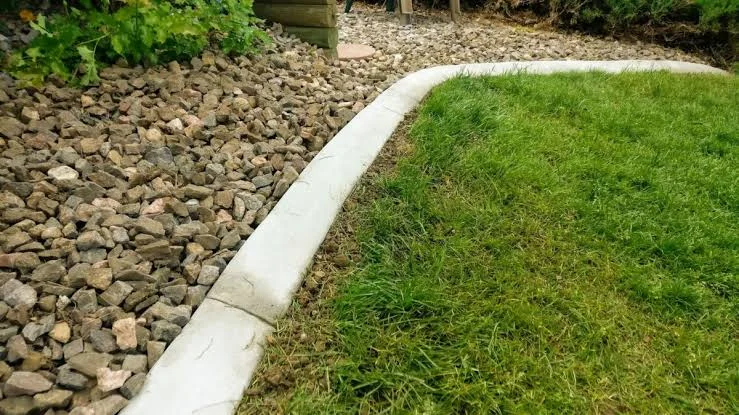
Short answer: a poured concrete edge in Edmonton usually lands somewhere between about $5 and $15 a running foot installed, and the length of the run matters more than anything else on the estimate. A single flower bed might be $300. Wrapping the front beds, the tree ring and the fence line can be $1,500 or more.
Below is where that number comes from, how deep the edge has to go to survive an Edmonton winter, and the one bylaw rule that catches people who are re-doing a whole front yard.
Where the price actually comes from
We publish our Edmonton flatwork rates openly: a standard 4-inch broom-finished slab runs about $10 to $15 per square foot, and ready-mix concrete itself runs roughly $180 to $250 per cubic yard.
Do the arithmetic on a 6-inch-wide edge and something useful falls out. Six inches wide is half a square foot of surface per running foot, so at flatwork rates the concrete surface is worth roughly $5.00 to $7.50 a foot. Now price the material on its own. A 6-inch-wide, 8-inch-deep edge uses about a third of a cubic foot of concrete per running foot, so 100 feet of edging is about 1.2 cubic yards. That is roughly $220 to $300 of concrete for a 100-foot run.
Read those two numbers side by side and the whole job makes sense. On a 100-foot run, the concrete might be $250 and the finished bill might be $800 to $1,200. You are not buying concrete. You are buying forming. A narrow ribbon has to be formed on both sides, staked, curved by hand, poured in small volumes, and finished by someone on their knees. That is why edging prices above flatwork per square foot even though it uses almost no material.
| Run length | Typical scope | Bracket at $5/ft | Bracket at $15/ft |
|---|---|---|---|
| 40 running feet | One front bed | $200 | $600 |
| 80 running feet | Front beds plus a tree ring | $400 | $1,200 |
| 120 running feet | Front yard beds and a side path edge | $600 | $1,800 |
| 200 running feet | Full front and back bed system | $1,000 | $3,000 |
Use the bracket to sanity-check a quote, not to replace one. For US comparison, national cost data puts installed landscape curbing at $5 to $18 per linear foot and a plain mow strip at $3 to $8 per linear foot, with total projects averaging $400 to $2,200. Those are US dollars and US labour markets, but the shape of the range matches what we see here.
Two Edmonton-specific things push a quote up. Pouring late in the season costs more, because cold-weather work adds 10 to 20%. And any run that a truck or a buggy cannot reach directly, which describes a lot of back gardens in Highlands, Ritchie or Glenora, adds wheelbarrow labour.
Our Edmonton concrete cost calculator has the current per-square-foot numbers for every flatwork type if you want to compare an edging run against a small patio or pad.
Mow strip, garden edge, curb: three different things
People use these words interchangeably. Contractors do not, and the difference changes the price.
| Type | What it is | Typical width | Sits at |
|---|---|---|---|
| Mow strip | Flat concrete ribbon the mower wheel rides on | 5 to 8 inches | Flush with the lawn |
| Garden edge | Low raised border that holds mulch or soil back | 4 to 6 inches | 1 to 3 inches proud of grade |
| Landscape curb | Shaped, often rounded or slanted decorative profile | 5 to 8 inches | 2 to 4 inches proud |
| Path edge | Thickened edge cast with a walkway | Part of the slab | Flush |
A mow strip is the cheapest of the four because it is flat, needs no shaped form, and the finish tolerance is loose. A shaped decorative curb costs more for the same length because the profile has to be formed or extruded and the finish is visible from the sidewalk.
If you are edging a path rather than a bed, it is often cheaper to have the edge cast as part of the walkway than added later. Worth raising when you price concrete walkways.
Concrete against plastic, steel and pavers
Here is the honest comparison for an Edmonton yard, where the ground freezes hard and thaws slowly.
| Edging type | Up-front cost | How it handles frost movement | Realistic service life |
|---|---|---|---|
| Plastic or poly roll | Lowest | Lifts and waves after a couple of winters; spikes work their way out | A few seasons |
| Steel or aluminum | Low to moderate | Holds line well, but can heave at joints and edges stay sharp | Long, if installed deep |
| Paver or block soldier course | Moderate | Individual units shift independently; needs periodic resetting | Long with maintenance |
| Poured concrete | Highest | Moves as one continuous piece; no individual units to shift | Longest, with hairline cracking expected |
| Precast concrete units | Moderate | Each unit moves on its own, like pavers | Long with resetting |
The reason poured concrete wins in a freeze-thaw climate is not strength. It is continuity. Plastic and pavers fail by pieces going out of alignment one at a time, which is exactly what happens when the ground under a yard freezes unevenly, then thaws unevenly in an Edmonton March. A continuous ribbon has no pieces to misalign. It will develop hairline cracks, and that is normal and cosmetic on a narrow element with nothing bearing on it.
What that buys you is fewer Saturdays. Nobody re-stakes a poured edge every spring.
How deep it has to go
A poured edge in Edmonton is typically 6 to 10 inches deep, and depth is doing two jobs at once.
The first is anchorage. A shallow ribbon sitting on topsoil has nothing to hold it. It needs to bear on compacted material, not on the loose stuff that a garden bed sits in.
The second is frost behaviour. Edmonton ground freezes deep and a narrow strip of concrete cannot be buried below frost the way a foundation is. Nobody digs a garden border to foundation depth. So the strategy is not to outrun frost, it is to let the edge move gently and come back. That means a granular base underneath so water does not sit against the concrete, a consistent depth so one section does not grip harder than the next, and control joints so the inevitable cracks land where you put them rather than where the concrete chooses.
An edge with no base, poured straight onto clay, will move unevenly. That is the single most common reason a two-year-old concrete border looks like a snake.
Heavy clay soil is common across large parts of the city and it holds water, which makes the base layer matter more here than it would in sandier ground. If your yard is already in the habit of staying soggy after a thaw, mention it at the quote stage. The same base logic drives concrete pads and patios.
The bylaw rule people miss
This one only bites if you are redoing a whole front yard, but it bites hard.
Edmonton’s Zoning Bylaw sets a minimum amount of soft landscaping on a residential lot. Soft landscaping is the living surface: grass, beds, plants. Concrete, gravel and paving are not.
The requirement is a minimum soft landscaped area equal to 30% of the total lot area for development in the RS and RSF zones, and 25% in the RSM zone. On top of that, the bylaw sets planting by site width:
| Site width | Required |
|---|---|
| Less than 8.0 m | 1 tree and 4 shrubs |
| 8.0 m to 15.0 m | 2 trees and 6 shrubs |
| Greater than 15.0 m | 4 trees and 8 shrubs |
Edging itself is a ribbon and rarely moves the percentage on its own. The trap is the project it usually belongs to. People edge the beds, then widen the driveway, then add a path, then gravel the strip beside the garage, and by the end of one summer a narrow lot has quietly lost a lot of green. On a narrow infill lot in a mature neighbourhood, 30% is closer than it sounds.
Check the number before you start the whole sequence, not after.
The drainage trap
A raised edge is a small dam. That is the point of it when it is holding mulch in. It is a problem when it is holding water against a foundation, or pushing it onto the yard next door.
The City is blunt about who owns this. Once your lot grading is approved, the Residential Lot Grading FAQ puts it plainly: “as the property owner, it is your obligation to maintain the lot grading permanently regardless of natural settlement or activity caused by yourself or damage by a 3rd party.”
Two rules keep you out of it. Never run a raised edge across the direction water is already travelling without leaving it somewhere to go. And never build a raised edge tight along a property line on the downhill side, because everything you stop lands on the fence line.
A flush mow strip sidesteps the problem entirely, which is one more reason it is the most popular choice on a sloped lot. Where a run genuinely needs to hold back grade rather than mulch, that is not edging any more. That is a retaining wall, and it comes with its own height rules and engineering questions.
How long the job takes
Most residential edging runs are a two-visit job.
Day one is layout, excavation, base, and forming. This is the long part, and it is most of the labour. Curves take longer than straight runs, because the form has to be bent and staked closer together.
Day two is the pour and finish, usually a few hours for a typical residential run.
After that, stay off it and keep it damp for the first few days. Beds can be refilled within about a week. If the pour lands in late season, protection is added, and that is where the 10 to 20% cold-weather premium shows up.
Getting a real number
Edging is one of the easier things to quote accurately, because it comes down to one measurement. Pace out the total length of every run you want, in feet, and note three things:
- Whether you want it flush with the lawn or standing proud
- How many curves and corners are in the run
- Whether a wheelbarrow can get to the back yard, or whether everything comes through a gate
Send those, and we can bracket the job before anyone visits. For anything past about 100 feet, or any run on a slope, we will want to walk the site, because the base and the drainage are what decide whether the edge is still straight in five years.
Book a quote or an on-site look through the site, and check the cost calculator first so you know what range you are working in.
FAQ
How much does concrete landscape edging cost in Edmonton? Roughly $5 to $15 per running foot installed for typical residential work. A 40-foot bed is commonly $200 to $600. A 200-foot full-yard system can reach $3,000. Length, curve count and access drive the number.
Is a concrete mow strip cheaper than decorative curbing? Yes. A flat mow strip has no shaped form and a looser finish standard. Decorative profiles cost more per foot for the same length.
How deep should concrete edging be in Edmonton? Usually 6 to 10 inches, on a compacted granular base. The base matters more than the extra inch of concrete. Edging is never buried below frost depth, so the goal is even, predictable movement rather than no movement.
Will it crack? Hairline cracking on a narrow ribbon is normal and cosmetic. Control joints put the cracks where you want them. Structural failure, meaning sections that separate or tip, comes from a missing or uneven base, not from the concrete.
Can it be poured in the fall? Yes, with cold-weather protection, and expect about 10 to 20% more. Spring and summer are cheaper and the cure is more forgiving.
Does edging need a permit? A flush or low garden edge is normally landscaping, not construction. What does need checking is the soft landscaping minimum of 30% of lot area in RS and RSF zones and 25% in RSM, especially if the edging is part of a larger hard-surfacing project.
Concrete or steel edging for a small bed? For a short, straight run under about 20 feet, steel is usually the better value. Concrete pulls ahead on long runs, tight curves, and anywhere a mower needs a surface to ride on.
Sources
- City of Edmonton Zoning Bylaw, 5.60 Landscaping: https://zoningbylaw.edmonton.ca/part-5-general-development-regulations/560-landscaping
- City of Edmonton, Lot Grading FAQ (Residential): https://www.edmonton.ca/residential_neighbourhoods/lot_grading/lot-grading-faq
- HomeGuide, Landscape Curbing Cost data: https://homeguide.com/costs/landscape-curbing-cost
