
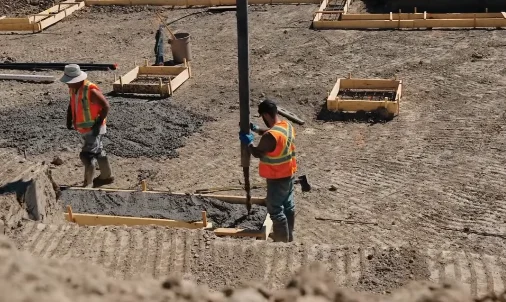
Here is the short answer, and it surprises most people: in Alberta there is no such thing as a licensed concrete contractor in the way there is a licensed electrician. Concrete Finisher is an optional certification trade. Nobody has to hold a ticket to pour your driveway.
So when a quote says “licensed and insured,” that phrase is doing less work than you think.
What does exist is two documents, and either one tells you more than the word “licensed” on a truck door. One is a City of Edmonton business licence. The other is a WCB clearance letter. Both take a few minutes to ask for, both are checkable, and the second one can save you from paying somebody else’s bill. Here is how each works and what to do when a contractor cannot produce them.
Why “Licensed” Means So Little for Concrete Work
Alberta sorts trades into compulsory certification and optional certification. Electricians and plumbers sit in the compulsory group: you need the ticket to do the work. Concrete Finisher sits in the optional group.
The provincial trade profile spells out who may work in it: “a registered apprentice, or working at a journeyperson level in the opinion of your employer (journeyperson certification optional).”
Read that last phrase again. In the opinion of your employer. A crew can be working entirely within the rules with nobody on site holding a certificate, as long as their employer considers them to be at journeyperson level. That is not a loophole somebody found. That is how the trade is structured.
For the record, the apprenticeship behind the optional ticket is real. It runs three periods, each requiring 1,200 hours of work experience, with four weeks of classroom instruction in the first two periods. A Red Seal exam is available at the end. A finisher who has done all that has genuinely earned something, and it is a fair thing to ask about.
But asking “are you licensed?” will get you a yes from almost anyone, because almost anyone can say yes truthfully. The better questions are about the two documents below.
Document One: The City of Edmonton Business Licence
This one is not optional, and it has nothing to do with concrete skill. It is about operating a business inside the city.
The City’s position is blunt: “every person or company that conducts business in Edmonton is required to have a business licence.”
Concrete work falls under the category called Construction, Contracting and Labour Service. The City defines it as “a business that performs, provides, or manages work, and may supply related materials in relation to the construction, assembly, demolition, inspection, cleaning, or maintenance of residential or commercial buildings, land, structures, infrastructure, or electrical or mechanical systems.”
The examples the City lists under that category name the trades directly: home inspectors, home builders, “Residential and commercial contractors,” “Construction trades,” general labour services, landscaping and others. A concrete crew pouring a driveway in Westwood is squarely inside it.
What to ask for
Ask for the business licence number and the legal name it is issued under. Then check that the legal name matches the name on your quote, your contract and the invoice you will eventually pay. Mismatches here are worth a pause. A licence in one name and an invoice in another means you do not actually know who you are contracting with, which matters a great deal if you later need to chase a warranty.
One Edmonton-specific wrinkle: our pour season is short, and the crews that chase it are mobile. Between the spring thaw and the fall freeze you will see trucks in Hazeldean and Keheewin that were in another province in February. A current city licence is the simplest filter between a business that is set up here and a crew passing through for a season.
Document Two: The WCB Clearance Letter
This is the one most homeowners have never heard of, and it is the one with your money attached to it.
A clearance letter comes from WCB-Alberta. In their words, it “states whether or not a contractor has coverage through WCB-Alberta, and if their account is in good standing.”
Now the part that matters to you. WCB’s guidance on timing: “You should get a clearance before you hire the company or individual and before releasing payment.”
And the consequence of skipping it: “If you do not have a clearance letter and the contractor has not paid their premiums, you may be liable for those premiums.”
That is your exposure in one sentence. Hire a crew with unpaid premiums, skip the clearance, and the unpaid amount can come looking for the homeowner who hired them. Clearance letters can be emailed, faxed or printed online, so there is no good reason to go without one.
The timing detail people miss
Note that WCB names two moments, not one: before you hire, and before you release payment. Those can be months apart on a project that waits out a wet spring in Lauderdale. An account in good standing in April is not proof of an account in good standing when the final payment goes out in September. On a job with a staged payment schedule, a second clearance before the last cheque is a reasonable thing to ask for, and a legitimate contractor will not be offended by the request.
Putting the Checks in Order
| Check | Who holds it | When to do it | What a miss tells you |
|---|---|---|---|
| City of Edmonton business licence | The business | Before signing | Not set up to operate in the city |
| WCB clearance letter | WCB-Alberta | Before hiring, and again before final payment | You may become liable for unpaid premiums |
| Legal name match across licence, contract and invoice | You | Before signing | You do not know who you are contracting with |
| Trade certification, if any | The individual finisher | During the quote conversation | Nothing, on its own — it is optional |
| Written contract with scope and payment schedule | Both | Before any money moves | No agreed scope to hold anyone to |
| Proof of liability insurance | The business | Before work starts | Damage to your property is your problem |
The order is deliberate. The licence and the clearance come first because they are documents a third party issues and a contractor cannot simply assert. Everything else on the list depends on what the contractor tells you.
What to Do If a Contractor Is Not Licensed
You have a direct route, and it does not require you to be certain.
The City asks residents to start by discussing the concern with the business owner. If that does not resolve it, record the address of the violation and a description of the problem, then call 311. Have your name, address and phone number ready, along with the details, in case your testimony is needed in court later.
From there, a file is created and a Municipal Enforcement Officer opens an investigation. The officer has room to judge the response. They may issue a warning notice with directions to fix the problem inside a set time frame, or issue a bylaw ticket. Ticket amounts start at $400 and climb from there depending on the type of business activity, how many days the business operated without a licence, and other circumstances.
Worth being clear about what this process is and is not. It addresses an unlicensed business. It is not a quality complaint process, and it will not get a bad driveway replaced. If your problem is workmanship rather than licensing, your contract is the instrument that matters, which is why the written agreement sits on the checklist above.
Before You Pay a Deposit
A few habits that cost nothing and change the odds.
Get the quote in writing with the scope described in plain terms: the area being poured, the thickness, the finish, the edge detail, what happens to the old concrete, and who is responsible for the mess. Vague scope is where disputes start.
Ask who is actually doing the work. Mobile crews subcontract, and the business on your licence check may not be the business on your lawn. If there is a sub involved, the clearance question applies to them too.
Ask how they handle our season. Edmonton’s pouring window closes earlier than most of the country, and a contractor who cannot give you a straight answer about what happens if your pour date slips into late fall has not thought about your job much.
Finally, know your own numbers before you take a quote. If you have not priced the work yet, run your measurements through our Edmonton concrete cost calculator first. Walking into a conversation with a realistic range is the cheapest protection against being talked into a number.
FAQ
Do concrete contractors need a licence in Alberta? Not a trade licence. Concrete Finisher is an optional certification trade, so journeyperson certification is not required to do the work. A business operating in Edmonton does need a City of Edmonton business licence.
How do I check if a contractor has a City of Edmonton business licence? Ask for the licence number and the legal business name, then confirm that name matches your quote, contract and invoice. If you believe a business is operating without a licence, call 311.
What is a WCB clearance letter and why do I need one? It states whether a contractor has coverage through WCB-Alberta and whether their account is in good standing. WCB advises getting one before you hire and before releasing payment, because without one you may be liable for the contractor’s unpaid premiums.
Is a Red Seal concrete finisher better than one without it? It is evidence of completed training: three apprenticeship periods of 1,200 hours each, with classroom instruction in the first two. It is worth asking about. It is not legally required, so its absence is not a red flag by itself.
What happens if I report a contractor operating without a licence? A file is created and a Municipal Enforcement Officer investigates. The officer may issue a warning notice with a deadline to fix the problem, or a bylaw ticket starting at $400 depending on the activity and the number of days operated without a licence.
Does this apply outside the city? The City of Edmonton business licence applies to business conducted in Edmonton. Sherwood Park, St. Albert, Spruce Grove, Leduc, Beaumont, Fort Saskatchewan and Stony Plain run their own licensing, so ask which municipalities a contractor is licensed in if your project is outside city limits. The WCB clearance letter is provincial and applies everywhere in Alberta.
Ask Us for Ours
We will hand over our business licence details and a current WCB clearance letter before you sign anything, and again before a final payment if you want a fresh one. That is a normal request, not an awkward one.
If you want a price and a timeline, we will come out, measure, and quote on site rather than over the phone. Driveways in Brintnell and walkways on a corner lot are different jobs with different drainage problems, and we would rather see it.
Ready for a number? Start with the cost calculator, then book a site visit for a driveway, walkway, pad or front steps.
Sources
- Concrete Finisher trade profile — Alberta Tradesecrets
- Clearance letters — WCB-Alberta
- Business Licence Categories — City of Edmonton
- Business Licence Concerns — City of Edmonton
