
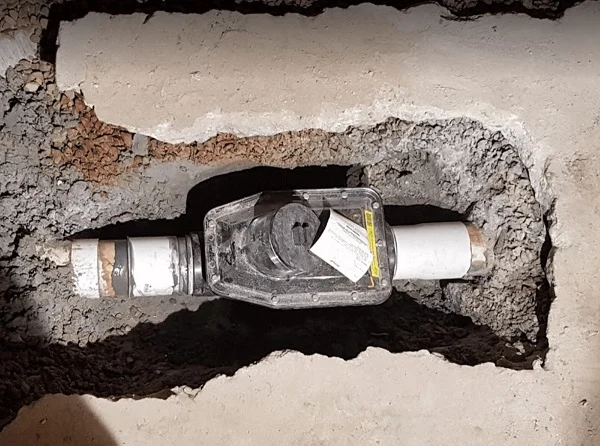
Short answer: the valve itself is the cheap part. In most Edmonton homes the real work is opening the basement floor to reach the sewer pipe, holding that hole open long enough for a City inspection, and then putting the concrete back so the valve stays reachable for the next thirty years.
EPCOR has a subsidy for the valve. It does not pay for the concrete. That line — between the plumbing invoice and the concrete invoice — is where almost every surprise on this job lives, so this page walks it end to end.
What a backwater valve actually is
A backwater valve is a one-way gate installed on the main sanitary sewer pipe — the single pipe that carries everything from your toilets, sinks and floor drain out to the City’s main line at your property boundary. Normally the flap sits open and wastewater flows out. When the main line surcharges (fills up faster than it can drain, usually in a heavy summer storm) the flap swings shut and holds the sewage out of your basement.
Two things follow from that, and EPCOR says both plainly.
First, while the flap is closed, nothing of yours can drain either. No toilets, no showers, no laundry, no dishwasher. If you keep running water during a storm, it has nowhere to go but back up through your own basement floor drain.
Second, the valve only works if it is maintained. EPCOR’s maintenance guidance is blunt about it: debris caught on the flap is the single most common reason one fails. That means somebody has to be able to get the lid off and look at it — which is the whole reason the concrete work matters.
Why this comes up so often in older Edmonton neighbourhoods
Homes built before 1989 were not required to have a backwater valve. That is most of the mature inner ring — Highlands, Ritchie, Bonnie Doon, Westmount, Parkallen, Forest Heights and the older parts of Mill Woods — and it is the group EPCOR’s subsidy program is aimed at.
If you have lifted the floor drain cover looking for a valve and found nothing, your house very likely does not have one.
What the EPCOR subsidy covers, and what it does not
EPCOR pays one fixed maximum per home toward installing an interior or exterior backwater valve, by cheque to the homeowner after the work is done. We deliberately do not print the figure here, because it is set by EPCOR’s funding year and the program is first-come, first-served with no guarantee of payment — check the current amount on EPCOR’s backwater valve subsidy page before you budget around it.
What matters more than the number is the shape of the program.
| Item | Covered by the subsidy? |
|---|---|
| An approved backwater valve, professionally installed | Yes, up to one fixed maximum per home |
| Valves outside the approved list | No |
| Installation you did yourself | No |
| A home that already has a valve | No |
| A second subsidy at the same address | No |
| Opening, backfilling and re-pouring the basement floor | No |
| Replacing flooring, baseboard or finishes you had to remove | No |
Only five valve types are on EPCOR’s approved list: Adapt-a-valve, Branch Line, Fullport, Retrofit, and Top Check Fullport. Buy outside that list and you have bought yourself out of the program.
To be eligible, your home has to be separately serviced — a single-family house or a duplex — with no existing valve and no previous subsidy at the address. EPCOR’s pre-approval inspection is suspended until further notice, but every other requirement still stands.
To claim, you email EPCOR three things: the City of Edmonton green sticker showing your permit number, a paid invoice showing professional installation and the valve model, and their completed application form. The invoice has to carry a City of Edmonton business licence or GST number.
The permit trap: doing it yourself costs you the cheque
This is the part worth reading twice, because the City’s rules and EPCOR’s rules point in opposite directions.
The City of Edmonton’s residential plumbing permit rules require a permit to install or alter a backwater valve. Like-for-like maintenance of an existing system in the same spot does not need one, but a new valve is not maintenance — it is an alteration, and it needs a permit.
A homeowner can pull that permit, but only for a single detached house they own and live in, and only if they do the work themselves. Any contractor doing the work has to be licensed with the City.
Now put the two side by side:
| Route | City permit | EPCOR subsidy |
|---|---|---|
| Licensed plumber does the work | Contractor pulls the permit | Eligible — you have an invoice with a licence or GST number |
| You pull a homeowner permit and do it yourself | Allowed, if you own and occupy the house | Not eligible — there is no professional invoice |
So the do-it-yourself route is legal and it is cheaper on paper, and it also disqualifies you from the subsidy. That trade-off is yours to make, but make it knowingly rather than finding out at the claim stage.
The City also warns that missing a required inspection can mean taking finished work back apart. On this job that is not a wall — it is your new concrete.
The part nobody quotes: opening and closing the floor
Your main sanitary line runs under the basement slab. An interior valve goes on that line, which means the floor has to come open. The sequence is fixed, and the order is what protects you.
- Locate the line. Usually it runs from the floor drain area toward the street-facing wall. Getting this right is the difference between a tidy cut and an exploratory one.
- Saw-cut and break out the slab. A clean cut line means a clean patch line later.
- Excavate down to the pipe and give the plumber working room on both sides of the valve.
- The plumber installs the valve.
- The City inspects — with the trench still open. This is the step people get wrong.
- Backfill in compacted layers, so the patch does not settle and crack in a year.
- Re-pour, finish, and set a flush access cover over the valve lid.
Step five is the whole reason to plan this properly. The inspection has to happen while the work is visible. Patch first and you are paying to break the same floor twice.
Step seven is the one homeowners forget to ask for. A backwater valve needs cleaning for as long as you own the house. If it gets buried under a smooth, seamless patch, the next person to maintain it needs a saw. A permanent access cover set flush with the finished floor costs very little at pour time and nothing at all afterward.
What moves the concrete side of the price
No two basements price the same. These are the six things we actually look at:
- Where the line runs relative to finished rooms, and whether we can work in an unfinished utility area instead of a bedroom.
- How deep the pipe sits below the slab, which sets how much material comes out and goes back.
- Slab thickness and whether there is reinforcing in it, which changes cutting and breakout time.
- The access route — a walk-out or a wide stairwell is a different job from a tight interior stair with a landing turn.
- What is on top of the floor. Bare concrete is simple. Tile, glued engineered flooring, or a developed basement with framing over the line all add removal and replacement.
- Dust and containment, which is a bigger line item in a finished, occupied home than in an empty utility room.
For an actual number on the concrete portion, start with our Edmonton concrete pricing page and then ask us for a site visit — this is not a job to price from a photo.
Three versions of the same job
| Situation | What the concrete work involves |
|---|---|
| Unfinished basement, line close to the floor drain | A modest saw-cut and patch, flush access cover, one mobilization |
| Finished basement over the line | Flooring and sometimes framing out and back, containment, more finishing work |
| Exterior valve in the yard instead | No floor cut, but excavation outside — and your driveway, walk or patio may be in the way |
That third row is worth a conversation before you choose interior or exterior. An exterior valve keeps your basement floor intact, and it can put your hard surfacing at risk instead. EPCOR also notes that a stubborn exterior valve can need its flapper and stem pulled by a qualified contractor, so access matters there too.
How the winter changes the schedule
Edmonton’s freeze-thaw cycling is the reason backfill compaction and a properly jointed patch matter more here than in a milder city. Ground movement works on a badly backfilled trench year after year until the patch cracks along the old saw line.
Interior work can run through the winter because the basement is heated. Exterior work is a different story — frozen ground is slower and more expensive to open, and spring is usually the better plan. We will tell you straight if waiting a few months is the cheaper answer.
If you are weighing this against other foundation and drainage work, our foundation services page covers what we do below grade, and our concrete foundations and footing and foundation pages cover the structural side.
Outside Edmonton
The subsidy described here is EPCOR’s Edmonton program, and the green sticker is a City of Edmonton permit. Sherwood Park, St. Albert, Spruce Grove, Leduc, Beaumont, Fort Saskatchewan and Stony Plain each have their own utility arrangements, their own permit desks, and in some cases no subsidy at all. Confirm locally before you plan around a rebate.
We do the concrete side of this work throughout those communities. The plumbing paperwork is the one part that changes with the address.
Where this page stops
We are a concrete contractor, not a plumbing contractor. We do not install backwater valves, we do not pull plumbing permits for you, and we do not decide whether you qualify for the subsidy.
We also do not publish the subsidy amount, the permit fee, or any code article number on this page. Those change, and getting them from us second-hand is worse than getting them from the source. Call 311 or read the City’s plumbing permit page for the permit side, and EPCOR’s flood prevention pages for the subsidy side.
What we can tell you is exactly what the floor work involves, in what order, and what it will take at your address.
FAQ
Do I need a permit to install a backwater valve in Edmonton? Yes. The City requires a plumbing permit to install or alter a backwater valve. Replacing an existing one like-for-like in the same location counts as maintenance and does not.
Can I install a backwater valve myself? If you own and occupy a single detached house, you can pull a homeowner plumbing permit and do the work yourself. You will not qualify for EPCOR’s subsidy, because the claim requires a paid invoice from a professional installer.
Does the subsidy cover cutting and patching the basement floor? No. The subsidy is toward the valve and its professional installation only. Concrete removal, backfill, re-pouring and any flooring you had to take up are yours.
Does my basement floor have to be opened? For an interior valve, yes — the sewer line runs under the slab. An exterior valve avoids the floor cut but means excavation in the yard instead.
Will I be able to maintain the valve after the floor is patched? Only if an access cover is set into the patch. Ask for it before the pour. Burying the lid means cutting the floor again the first time the valve needs cleaning.
My house was built in the 1990s. Do I already have one? Probably. Homes built before 1989 were not required to have a valve, so newer homes usually do. Lift the cover and look before you budget for anything.
Get a straight answer before you book the plumber
The cheapest version of this job is the one that is sequenced right: permit first, valve and inspection with the trench open, then one clean patch with an access cover in it. The expensive version is the one where the concrete goes back twice.
Send us your address and a photo of your floor drain area and we will tell you what the concrete side looks like, what order to book it in, and whether an exterior valve would be the smarter call at your house. If we think you should wait for spring, we will say so.
