
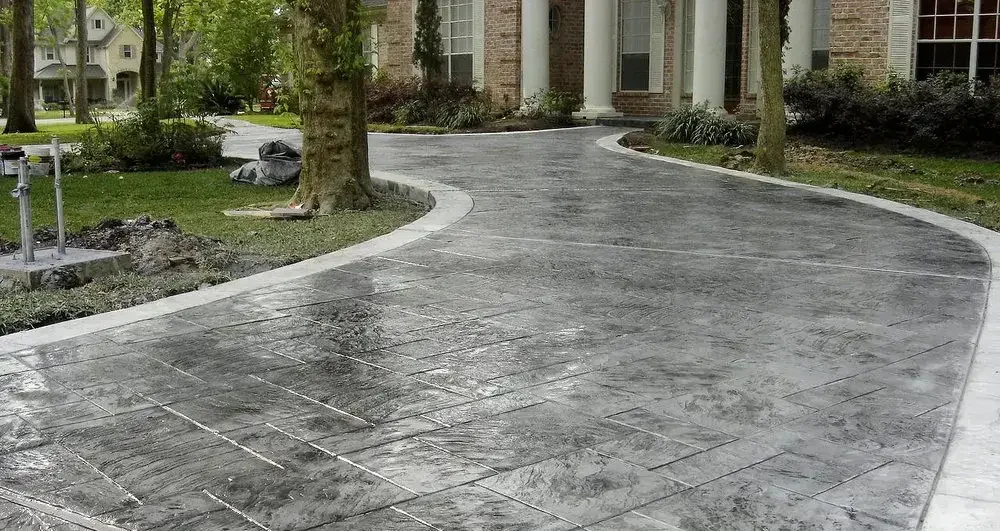
Stamped concrete gets sold on the photo. In central Alberta it should be sold on the winter.
The pattern you choose, the sealer schedule you commit to, and how the slab drains matter far more here than they do in a milder climate. This is what actually holds up in Sherwood Park, Spruce Grove, St. Albert and the rest of the Edmonton region — and what to ask before you book.
Why the climate changes the decision
Edmonton and its surrounding communities go through roughly 100 freeze–thaw cycles a year. Every one of them is a chance for water sitting in or on the surface to expand.
Stamped concrete is more exposed to this than a broom finish for one structural reason: the pattern creates low points. Grout lines, joint impressions and deep textures all hold water. Where a broom finish sheds, a stamped surface can pond in the detail.
That is not an argument against stamped concrete. It is an argument for three specific things:
- A mix specified for freeze–thaw exposure, with proper air entrainment
- A pattern whose relief is not so deep that it traps standing water
- A sealing schedule that is actually followed
Our post on choosing the right concrete mix for the Edmonton climate covers the first point in detail. It is the one people skip, and it is the one that decides whether the surface scales.
Which patterns survive here
Not all stamp patterns age the same way in a cold climate.
Ashlar slate and seamless slate. Shallow, even relief. Water sheds rather than pooling. The most forgiving family of patterns for this region and the reason they are the most common.
Random stone and flagstone. Moderate relief with irregular grout lines. Works well when the slab is graded properly; less forgiving on a flat slab that holds water.
Wood plank. Popular and genuinely attractive, but the plank joints run in one direction. On a slab graded across the grain rather than along it, water sits in every joint. Orientation matters here more than with any other pattern.
Deep cobblestone and heavy texture. The most dramatic and the most demanding. Deep relief holds water, snow and ice-melt residue. Choose it knowing the maintenance is higher.
Border and banding. A contrasting border with a simpler field is a good compromise — visual interest where you look, less texture across the area that takes the traffic.
Colour, and how it ages
Two ways to get colour into stamped concrete, and they age very differently.
Integral colour is mixed through the concrete. It fades slowly and evenly, and a chip or scuff shows the same colour underneath.
Surface-applied colour — colour hardeners and release agents — sits on top. It gives richer, more varied tones, which is why it is used for realistic stone effects. But it wears where traffic concentrates, and UV works on it.
Most quality stamped work in this region uses both: integral colour as the base so wear is not stark, surface colour for depth. Our guide to coloured concrete in Edmonton breaks down the options and what each costs to maintain.
The sealing schedule is not optional
This is the single biggest difference between stamped concrete that looks good at year ten and stamped concrete that looks tired at year four.
Stamped concrete needs resealing on a regular cycle. In this climate the sealer is doing two jobs: protecting the colour from UV, and keeping water and de-icer out of the surface.
Two failure modes to know about:
Skipping the reseal. The surface goes dull, then the colour thins in traffic areas, then de-icer starts to work on the paste itself.
Sealing wrong. Sealing over a damp slab, or applying too heavy a coat, traps moisture and produces a white haze or blistering. More sealer is not better.
The practical rule: ask your contractor for the reseal interval in writing, and put it in your calendar. It is a small annual cost that protects a large one-time cost.
Drainage and the freeze–thaw problem
Everything above assumes the water leaves. Where it does not, no mix and no sealer saves the surface.
Our post on what Edmonton weather does to concrete covers the mechanism in detail. The short version for stamped work:
- Positive slope away from the house across the entire surface, no exceptions
- No low spots where the pattern relief can hold standing water
- Downspouts discharging clear of the slab, not onto it
- Pattern orientation working with the slope, not across it
What changes town to town
The concrete does not change. These do:
Permits and lot grading. Sherwood Park (Strathcona County), Spruce Grove, St. Albert, Beaumont, Stony Plain and Fort Saskatchewan each administer their own requirements. At-grade patios and driveway replacements are treated differently from raised structures or anything that changes drainage. Check with the municipality before booking.
Newer subdivisions and grading approvals. Many newer lots in these communities are under an active lot grading approval. If yours is, the finished elevation may need to be certified — confirm before the pour, not after.
Driveway crossings and boulevard. Where a driveway meets the municipal sidewalk or boulevard, the town has a say. This is a common surprise on driveway replacements.
Scheduling. Crews group out-of-city work geographically. A job in Spruce Grove books differently from a job in central Edmonton. Booking earlier gets you a better slot.
What to send with an enquiry
- Municipality and address
- Approximate dimensions and what the surface is for — patio, driveway, walkway, pool deck
- Photos including where water currently drains
- Whether the lot has an active grading approval
- Any pattern or colour you have in mind, or a request to be shown options
- Access for a truck
FAQ
Do you do stamped concrete in Sherwood Park, Spruce Grove and St. Albert? Yes. Edmonton Concrete Services works throughout the Edmonton region including Sherwood Park, Spruce Grove, St. Albert, Beaumont, Stony Plain and Fort Saskatchewan. Out-of-city scheduling is grouped by area.
Does stamped concrete hold up in Edmonton winters? Yes, when it is specified and maintained for the climate — an air-entrained mix rated for freeze–thaw exposure, a pattern that does not trap standing water, correct drainage, and resealing on schedule. Stamped concrete that fails here almost always failed on one of those four.
How often does stamped concrete need resealing? On a regular cycle, and more often on surfaces that get heavy traffic or de-icer. Ask your contractor for the specific interval for the sealer used on your job and follow it.
Which stamp pattern is best for a cold climate? Shallower, evenly textured patterns such as ashlar and seamless slate shed water best. Deep-relief patterns like heavy cobblestone look dramatic but hold water and need more maintenance.
Is stamped concrete slippery in winter? Texture helps, but any hard surface is slippery under ice. Sealer choice affects this — some sealers can be specified with a slip-resistant additive. Raise it before the job, not after.
Can I use ice melt on stamped concrete? Chloride de-icers attack concrete surfaces and shorten sealer life. Sand is the safer choice. If de-icer is unavoidable, keep the resealing schedule tight.
Do I need a permit for a stamped concrete patio in Sherwood Park or St. Albert? It depends on the municipality, the patio type and whether it changes drainage. At-grade work is often treated differently from raised structures. Confirm with the town or county office before booking.
Planning stamped concrete outside Edmonton?
Edmonton Concrete Services works across Sherwood Park, Spruce Grove, St. Albert and the surrounding communities. Send photos and your address — we will tell you which patterns suit your grade before we talk about colour.
