
Industrial concrete warehouse floors are designed to handle heavy forklift traffic, racking loads, and constant daily wear in demanding industrial environments.
Warehouse concrete looks “simple” until the first winter, the first busy season, or the first week of forklift traffic. Then the real questions show up: Why is the floor dusting? Why are joints breaking at the edges? Why does a lift truck feel like it’s hopping over every panel line?
Here’s the problem: many industrial concrete failures aren’t caused by the concrete mix alone. They come from what happens before the pour (subgrade and moisture planning), during the pour (finishing windows and flatness control), and after the pour (curing, joint protection, and early traffic timing). Industry guides like ACI’s floor and slab recommendations emphasize that quality floors depend on site prep, joint details, workmanship, and curing—not just “higher strength.”
In this Edmonton-focused guide, you’ll learn how industrial concrete warehouse floors and loading docks are designed to handle forklift traffic, racking loads, impact zones, and Canadian freeze-thaw conditions—plus what to specify and inspect so you avoid costly rework.
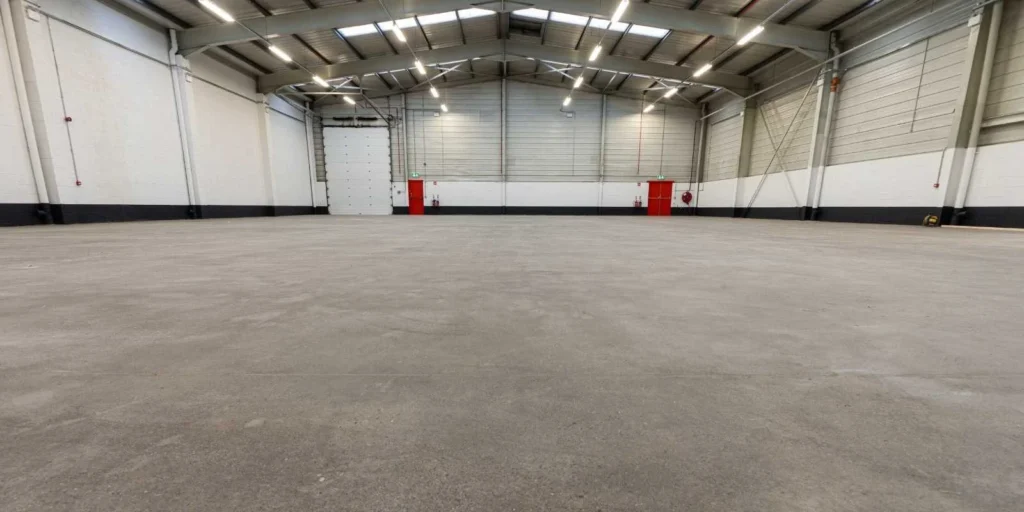
What “Industrial Concrete” Really Means for Warehouses & Docks
Warehouse Floors vs. Loading Docks: Two Different Stress Profiles
Warehouse floors are all about rolling loads and precision. Forklifts apply repeated wheel loads, turning forces, and abrasion day after day. Racking systems add concentrated “point loads” where posts bear directly onto the slab. And if you run narrow-aisle equipment or high-bay racking, floor flatness becomes a performance requirement—not a nice-to-have. ACI’s slab-on-ground design guidance explicitly covers loads from stored materials, rack loads, and static/dynamic equipment traffic.
Loading docks are the opposite: fewer square feet, but far more punishment per foot. Docks and aprons get impact from trailers, repeated axle loads, plow scrapes, wet freeze-thaw cycling, and de-icing salts. That’s why exterior dock concrete needs a durability strategy, proper drainage, and strong edge detailing—especially in Edmonton’s seasonal swings.
Common Use Cases in Edmonton Industrial Facilities
- Distribution & logistics: high forklift traffic, tight turning paths, joint wear
- Manufacturing bays: heavy equipment loads, vibration, chemical exposure zones
- Service yards & docks: impact edges, salt exposure, snowmelt drainage challenges
- Multi-tenant industrial: durability plus fast repair options to minimize downtime
Key Performance Outcomes You’re Actually Buying
Industrial concrete is about measurable outcomes. If you’re clear about these up front, you can design the slab, joints, and finish to match the building’s real use.
- Flatness/Levelness (FF/FL): how “true” the floor is for racking and equipment paths (measured, not guessed). ASTM E1155 is the standard method used to turn elevation readings into FF/FL numbers.
- Joint performance: whether joints stay tight and durable under hard-wheel traffic (forklifts are tough on edges)
- Crack control: directing shrinkage movement into planned joints instead of random cracking
- Abrasion resistance: preventing early wear and “powdering” from repeated traffic
- Moisture control: protecting coatings/finishes and reducing long-term surface issues
Comparison: Warehouse Floor vs. Loading Dock Concrete (At a Glance)
| Category | Warehouse Floors | Loading Docks & Aprons |
|---|---|---|
| Primary Stress | Forklift rolling loads, racking point loads | Impact, truck loads, plow/salt, freeze-thaw |
| Top Failure Risk | Joint spalling, curling, dusting, flatness issues | Scaling, edge breaks, ponding water, settlement |
| Key Spec Focus | FF/FL, joint layout, load transfer, surface hardening | Drainage slope, durability, edge detailing, air-void system (often) |
| Best ROI Detail | Joint protection for hard-wheel traffic | Drainage + freeze-thaw-resistant concrete practices |
Pre-Construction Planning: Specs That Prevent Expensive Rework
Start With Loads: Forklifts, Racking, and Point Load Reality
If you only remember one thing: the slab is a structural system, not just a surface. That system includes the concrete, the base, and how loads transfer across joints. ACI’s slabs-on-ground guidance highlights that industrial slabs must be designed for stored materials on the slab, rack loads, and vehicle/equipment loads.
Practical planning questions we ask on Edmonton projects:
- What forklift type, wheel configuration, and traffic pattern will you run (straight aisles vs. constant turning)?
- Where will racking posts land, and can you provide rack layout early?
- Are there future mezzanines, heavier equipment, or a change from storage to manufacturing?
- Will the floor need coatings, polished finish, or dustproofing from day one?
Flatness/Levelness Targets: Standard vs. High-Performance Floors
Flatness is one of those details you don’t notice—until you really need it. FF (floor flatness) and FL (floor levelness) are standardized measurements derived from elevation readings and calculated using ASTM E1155.
Why it matters:
- Racking stability: uneven floors can create shimming issues, stress rack frames, and complicate installation.
- Equipment performance: lift trucks handle better, carry more safely, and experience less wear on smoother, flatter routes.
- Drainage control: in some facilities, you need controlled slopes or specific transitions at doorways.
Friendly rule of thumb: if you’re running high-bay racking, narrow aisles, or precision automation, bring flatness requirements into the conversation early—because flatness is strongly influenced by pour strategy and finishing method, not by “fixing it later.” (Industry resources note that higher FF/FL numbers represent better flatness/levelness and are evaluated soon after placement.)
Joint Strategy: Fewer Joints vs. “Joints Done Right”
Joints are where industrial floors either behave beautifully—or start to fall apart under hard wheels. The goal isn’t “no joints.” The goal is planned movement with protected edges.
ACI’s floor guidance calls out a key reality for warehouses: areas subject to hard-wheel material-handling traffic should use a semi-rigid filler to help minimize wear and damage at joint edges.
“Floor areas subject to the hard wheels of material-handling vehicle traffic should be filled with a semi-rigid filler to minimize wear and damage to joint edges.”
What “joints done right” typically includes:
- Layout that respects geometry: avoiding awkward short panels and re-entrant corners where cracks love to start.
- Proper saw-cut timing: cutting early enough to “catch” shrinkage before random cracking begins (timing is a common miss on fast-paced sites).
- Load transfer where needed: dowels or designed joint details that reduce differential movement at joints in heavy traffic lanes.
- Protection for hard-wheel traffic: semi-rigid joint fillers or armoring strategies appropriate to your operations.
Moisture Plan: Vapor Barriers, Drainage, and Coating Compatibility
Moisture is the “silent influencer” of industrial floor performance. It impacts dusting, curling, and whether coatings or densifiers stay bonded long-term. If you plan to coat the slab (epoxy/urethane systems), moisture control becomes even more important because moisture vapor can push against coatings from below and lead to failures if not tested and addressed.
For loading docks and exterior aprons, moisture planning also means drainage: water that ponds and refreezes near dock edges accelerates surface damage and safety risks.
Cold Weather & Seasonal Pour Planning (Edmonton Reality)
Edmonton pours often happen across big temperature swings. That changes your finishing window and your strength-gain timeline. The solution isn’t guesswork—it’s a plan: temperature management, curing strategy, and realistic schedules so the slab isn’t forced into early traffic before it’s ready.
One practical benchmark used in curing discussions: ACI curing guidance is often referenced as targeting substantial early strength before curing ends (commonly discussed around achieving a significant portion of design strength), which underscores why curing and protection are not optional on industrial work.
Subgrade & Base Prep: The Hidden Make-or-Break Layer
Soils, Compaction, and Proof-Rolling
If a warehouse floor fails, people blame the concrete. But many of the worst problems start below it. A slab-on-grade is only as stable as the ground supporting it. ACI’s slabs-on-ground guidance emphasizes that slabs must accommodate movement, minimize shrinkage cracking, and resist applied loads—none of that works if the base is inconsistent.
In real-world Edmonton projects, subgrade issues often show up as:
- Soft spots that settle after the slab is placed (leading to low areas and joint faulting)
- Pumping where water and fines migrate under repeated loads
- Differential settlement at doorways and dock approaches where traffic and water exposure are highest
Good prep means consistent compaction, stable grades, and verification steps (including proof-rolling or other checks depending on the project). It’s not glamorous—but it’s usually the best money you’ll spend.
Granular Base Thickness and Material Selection
The granular base isn’t just “gravel under concrete.” It has a job:
- Uniform support to reduce stress concentrations in the slab
- Drainage/capillary break to manage moisture movement
- Work platform so the crew can place concrete properly without contaminating the mix with mud and fines
In industrial settings, base quality directly impacts how well joints perform and how much the slab moves over time under repetitive forklift paths.
Vapor Barrier & Insulation Considerations
Where moisture sensitivity is a concern (warehouses that will be coated, polished, or used for moisture-sensitive storage), vapor barriers can be part of the solution. The key is that they must be installed correctly and protected during construction so they don’t get punctured or compromised.
Insulation under slabs can also be relevant in certain heated industrial spaces or frost-related designs. The “right” approach depends on use, heating strategy, and performance goals—so we recommend aligning this with your project team early (GC, engineer, and concrete contractor).
Quality Control Points (Owner/GC Checklist)
- Compaction verification: base is consistent, not just “rolled over once.”
- Grade checks: elevations and slopes confirmed before concrete arrives.
- Vapor barrier integrity: seams lapped/taped, penetrations sealed, damage repaired before placement.
- Drainage confirmations: exterior dock areas slope away from doors and don’t create ponding zones.
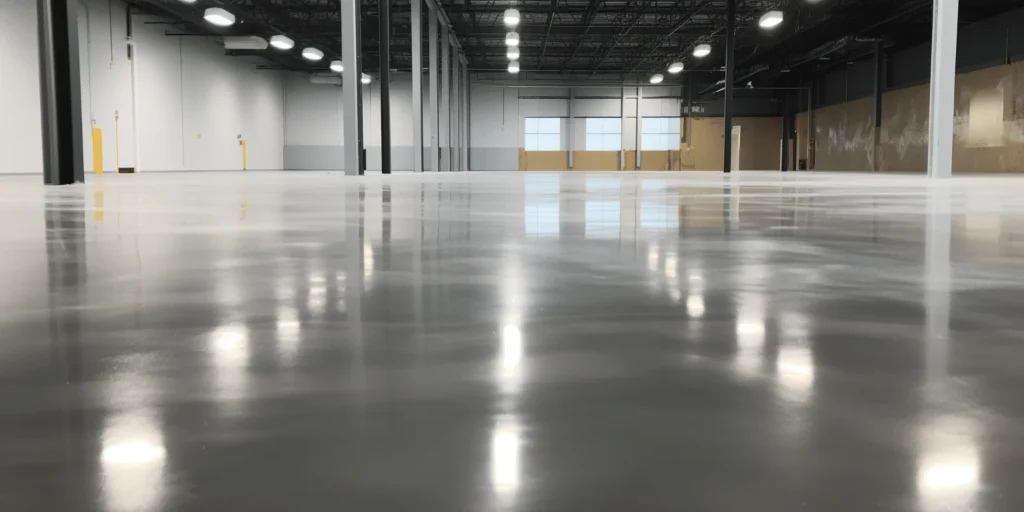
Quick Takeaways So Far (Before You Pour)
- Industrial concrete starts with load planning: forklifts and racking drive the slab design approach.
- Flatness (FF/FL) is measurable and should be discussed early if your operation requires precision.
- Joints are a performance feature, especially under hard-wheel traffic—protecting joint edges is a known best practice.
- The base is the foundation: consistent support and moisture planning prevent many “mystery” floor failures later.
Ready to plan a warehouse slab or dock apron in Edmonton? If you can share your building size, intended use (forklifts/racking), and timeline, our team can help you define the right scope and priorities before you commit to a pour date.
Request a site walk & quote from Edmonton Concrete Services — we’ll review traffic patterns, base conditions, and the details that protect your investment.
FAQ (Part 1 — Planning & Prep)
What’s the biggest mistake that causes warehouse floor cracking?
Skipping the “boring” steps: inconsistent subgrade support, rushed joint planning, and poor moisture strategy. The slab can’t perform as designed if the ground beneath it moves or varies across the building footprint.
Do I really need FF/FL numbers for a warehouse floor?
Not always. If you’re doing general storage with wide aisles, a standard flatwork approach may be fine. But if you have high-bay racking, narrow-aisle equipment, or automation, FF/FL targets (tested using ASTM E1155 methods) help ensure the floor matches the operational need.
Why do forklift floors break at the joints?
Hard wheels are tough on joint edges—especially if joints are poorly timed, too wide, or lack the right protection. Industry guidance notes that semi-rigid fillers can help minimize wear and edge damage in hard-wheel traffic
Concrete Mix Design for Warehouse Floors & Loading Docks
Strength Is Not the Whole Story
When owners ask for “a stronger mix,” what they usually want is a floor that doesn’t dust, doesn’t chip at the joints, and doesn’t need constant patching. Compressive strength matters—but on an industrial concrete warehouse floor, long-term performance comes from a balanced mix design that supports:
- Lower shrinkage risk (to help crack control and reduce joint opening)
- Surface durability for abrasion and hard-wheel traffic
- Workability that allows proper placement and finishing without adding water on-site
- Compatibility with densifiers or coating systems if you plan to protect the slab
For slab-on-ground design, ACI guidance makes it clear that industrial slabs need to resist real-world load cases—stored materials, storage rack loads, and static/dynamic equipment loads—so your design inputs should come first, then the mix is selected to support those goals.
Air Entrainment: Interior Slabs vs. Exterior Dock Aprons
This is where warehouse floors and loading docks split:
- Interior warehouse floors are typically focused on finishing quality, flatness, abrasion resistance, and densification/coating compatibility.
- Exterior loading docks, ramps, and aprons often face freeze-thaw cycling and de-icing salts—so durability practices become essential.
Concrete industry guidance for exterior slabs exposed to freezing and thawing with deicers commonly recommends ordering good-quality air-entrained concrete and a specified strength around 4000 psi (28 MPa) for severe conditions.
Reinforcement Options: Rebar, Wire Mesh, Fibers, or Hybrid
Reinforcement is often misunderstood, so here’s the practical version:
- Rebar: helps with structural capacity and crack control in specific designs, especially where loads or details call for it.
- Wire mesh: can help with crack control if correctly supported and placed at the right depth—poor placement reduces value fast.
- Fibers: commonly used to reduce plastic shrinkage cracking and improve toughness; different fiber types do different jobs.
- Hybrid approaches: used when you need multiple benefits (for example, crack control + durability + joint performance).
Important: reinforcement does not “prevent cracking.” Concrete shrinks as it cures; reinforcement helps manage crack behavior and serviceability. The crack plan still relies heavily on joint layout and curing discipline.
Admixtures and Add-ons That Matter in Industrial Work
Industrial concrete projects often benefit from mix tools that improve consistency and long-term wear:
- Water reducers to maintain workability without adding water
- Set control for seasonal temperatures and finishing windows
- Shrinkage reduction strategies (mix-specific) where joint performance is critical
- Durability-focused choices for exterior slabs exposed to moisture and deicing salts
For docks in particular, you want durability decisions aligned with recognized guidance on scaling risk and freeze-thaw exposure.
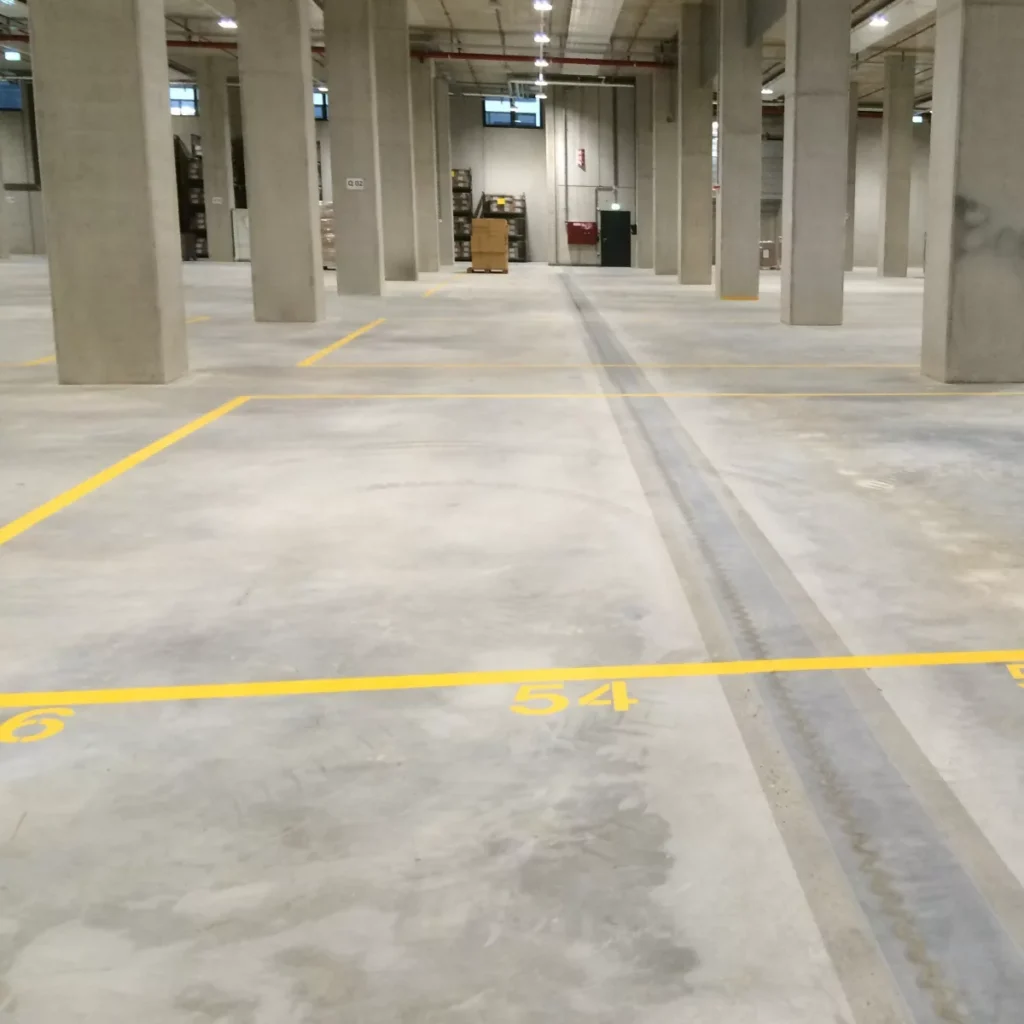
Pouring & Finishing: How Great Warehouse Slabs Are Actually Built
Placement Strategy: Panel Sizes, Pour Sequencing, and Crew Coordination
A high-performing industrial concrete warehouse floor isn’t just “poured.” It’s executed with a plan that respects time, temperature, and finishing windows. That includes:
- Pour sequencing that prevents cold joints and supports consistent finishing
- Panel sizing that matches joint strategy and flatness goals
- Logistics that keep concrete arriving on schedule (consistent slump/temperature)
Real-world example: If a large bay is placed too slowly, you can end up finishing different areas at different moisture states—one zone overworked, another still bleeding—leading to inconsistent wear and future dusting.
Laser Screeds and Leveling Methods
On large warehouse slabs, leveling methods can make or break your flatness outcomes. If your operation depends on straight tracking and stable racking, it’s worth discussing measurable FF/FL outcomes early. ASTM E1155 is the standard test method used to determine FF flatness and FL levelness numbers.
Finishes for Warehouses
Common warehouse floor finishes (chosen based on use and protection strategy) include:
- Hard-troweled finish for dense, durable surfaces in dry industrial settings
- Polished concrete for dust reduction and cleanability where appropriate
- Textured/broom finishes for ramps or exterior transitions where slip resistance matters
Curing: The Most Skipped Step With the Biggest Consequences
If you want an industrial slab to last, curing is non-negotiable. Curing supports strength gain, surface durability, and reduced curling/cracking risk.
“Recommended minimum duration of curing” for ASTM C150 Type I cement is commonly listed as 7 days in ACI curing guidance.
Highway and pavement guidance also reinforces the “time or strength” concept: curing is often maintained for about 7 days (under suitable temperatures) or until concrete reaches about 70% of specified strength.
What poor curing looks like later: early dusting, surface weakness, faster abrasion, and joints that start breaking down sooner than they should.
Flatness Testing and Sign-Off
If flatness matters, measure it. ASTM E1155 provides a quantitative method to evaluate FF/FL numbers, and those results can be documented for acceptance.
Joints, Edges, and Details That Decide Long-Term Performance
Control Joints vs. Construction Joints
Industrial slabs need a joint plan that makes sense for the building layout and traffic patterns:
- Control (contraction) joints are placed to encourage shrinkage movement to occur at planned locations.
- Construction joints happen where placements stop and start; they must be detailed to perform under load.
Joint Protection for Forklift Traffic
Forklift wheels punish joint edges. That’s why recognized floor guidance recommends filling joints in hard-wheel traffic areas with a semi-rigid filler to minimize wear and edge damage.
In simple terms: if your warehouse runs forklifts all day, unprotected joints often become your first maintenance headache.
Dock Edges, Doorways, and High-Impact Zones
Edges are where concrete gets “tested.” The best loading dock concrete details typically focus on:
- Edge strength and thoughtful transitions
- Drainage so water doesn’t pond and refreeze near doors
- Protection (guards, bollards, bumpers) where impacts are expected
Protective Treatments: Dustproofing, Densifiers, Sealers, and Coatings
When a Densifier Is Enough
For many industrial spaces, a densifier can be a practical, cost-effective way to reduce dusting and improve cleanability—especially when paired with good curing and finishing. The goal is a tighter, harder surface that stands up better to repeated traffic.
When You Need a Coating System
Coatings are often used where you have:
- Frequent washdowns or hygiene requirements
- Chemical exposure (oils, acids, cleaning agents)
- Color zoning for safety lanes and operational flow
Key warning: many coating failures trace back to moisture and surface preparation. If you’re planning coatings, include moisture evaluation and a surface-prep plan in the scope—not as an afterthought.
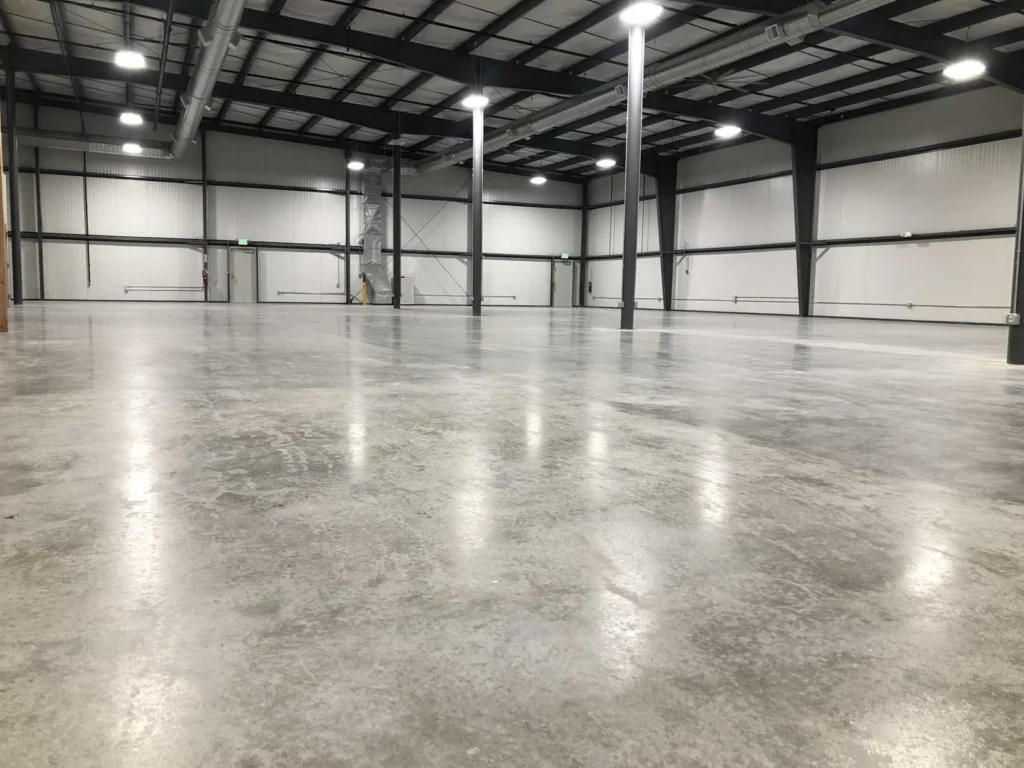
Comparison Table: Common Warehouse Floor Protection Options
| Option | Best For | Pros | Watch-Out | Typical Downtime |
|---|---|---|---|---|
| Densifier (dustproofing) | General warehouse use, polished paths | Reduces dusting, improves wear, lower cost | Won’t “fix” structural issues or bad joints | Low–Moderate (project-dependent) |
| Epoxy coating | Cleanability, light chemical exposure | Easy to clean, professional look | Moisture and prep sensitivity | Moderate |
| Urethane topcoat system | Higher wear and chemical resistance | Tougher surface performance | Requires correct system selection and prep | Moderate–Higher |
Loading Docks Done Right: Aprons, Ramps, Drainage, and Impact Resistance
Dock Aprons: The Most Abused Concrete on the Site
Loading dock concrete fails faster than most people expect because it’s exposed to a perfect storm: heavy loads, impacts, moisture, and de-icing salts. When docks scale, spall, or break at the edges, operations suffer immediately.
Drainage and Water Management
Drainage is a durability strategy. Even strong concrete will degrade faster if water ponds at the dock edge, refreezes, and repeatedly cycles through freeze-thaw conditions.
Freeze-Thaw & De-Icing Salt Defense
To reduce scaling risk on exterior slabs, recognized industry guidance recommends ordering air-entrained concrete and appropriate strength levels for severe exposure, plus following best practices for placement, finishing, and curing.
In plain terms: the “winter proof” dock isn’t one magic product—it’s the combination of durability-focused concrete, good curing, smart drainage, and realistic early-use timing.
Industrial Concrete Repairs: What to Fix Now vs. What to Monitor
Common Warehouse Floor Failures
- Joint spalling (broken edges under hard-wheel traffic)
- Random cracking outside joint lines
- Dusting and surface abrasion
- Curling (edges lifting slightly due to moisture/temperature gradients)
- Settlement at doorways, aisles, and heavy traffic routes
Common Dock Failures
- Scaling from freeze-thaw + moisture + deicers
- Edge breaks from impacts and repetitive axle loads
- Ponding and drainage-related deterioration
Repair Options (A Practical Decision Path)
- Cracks: seal or treat based on movement, location, and function (cosmetic vs. structural vs. moisture pathway).
- Joints: rebuild spalled edges, then protect with the right joint filler strategy for hard wheels.
- Surface wear/dusting: mechanical prep + densifier or coating, depending on use.
- Settlement: address root cause (base support/water) before surface patching becomes a repeat expense.
Downtime Planning (Operations-Friendly Repairs)
Industrial repairs succeed when they respect operations. We often phase repairs by aisle, schedule work off-hours when possible, and plan cure windows so traffic returns safely—without sacrificing long-term bond and durability.
Cost Drivers & Budgeting: What Impacts Price the Most
New Slab Costs: The Real Variables
Industrial concrete pricing is driven less by square footage and more by performance requirements. The biggest cost drivers typically include:
- Subgrade remediation (proof-rolling results, soft spot removal, base rebuild)
- Slab thickness and reinforcement aligned with real load cases
- Flatness targets (FF/FL) and associated placing/finishing methods
- Joint design and joint protection systems for forklift traffic
- Protection systems (densifier/coatings) and prep requirements
Dock Costs: Why Edges, Drainage, and Details Add Up
Loading docks cost more per square foot because they require more detailing: robust edges, drainage control, and durability-focused concrete practices for freeze-thaw exposure.
How to Choose the Right Industrial Concrete Contractor in Edmonton
Questions to Ask (That Reveal Experience Fast)
- How do you evaluate and verify subgrade compaction before the pour?
- Will you provide a joint layout plan based on slab geometry and traffic?
- How do you handle hard-wheel forklift joint protection?
- What’s your curing plan (duration and method) for industrial slabs?
- If flatness matters, how will you measure FF/FL (ASTM E1155) and document results?
What You Should Expect in Writing
- Scope that defines loads, finish, joints, and protection strategy
- Concrete placement plan (sequencing, cold-weather plan if needed)
- Quality checkpoints (base, moisture, curing, and acceptance criteria)
How Edmonton Concrete Services Approaches Industrial Floors & Docks
We build industrial concrete warehouse floors and loading docks with a “performance first” mindset: clear load assumptions, disciplined base prep, measurable flatness targets when required, joint plans suited to forklift traffic, and curing strategies aligned with recognized guidance.
Real-World Scenarios (What We See Most Often)
Scenario 1: Forklift Aisles Rocking at Joints
What’s happening: hard-wheel traffic is chipping joint edges or causing uneven transitions.
Common root causes: joints not protected for
Well-built industrial concrete warehouse floors reduce downtime, protect equipment, and extend the service life of your facility.
