
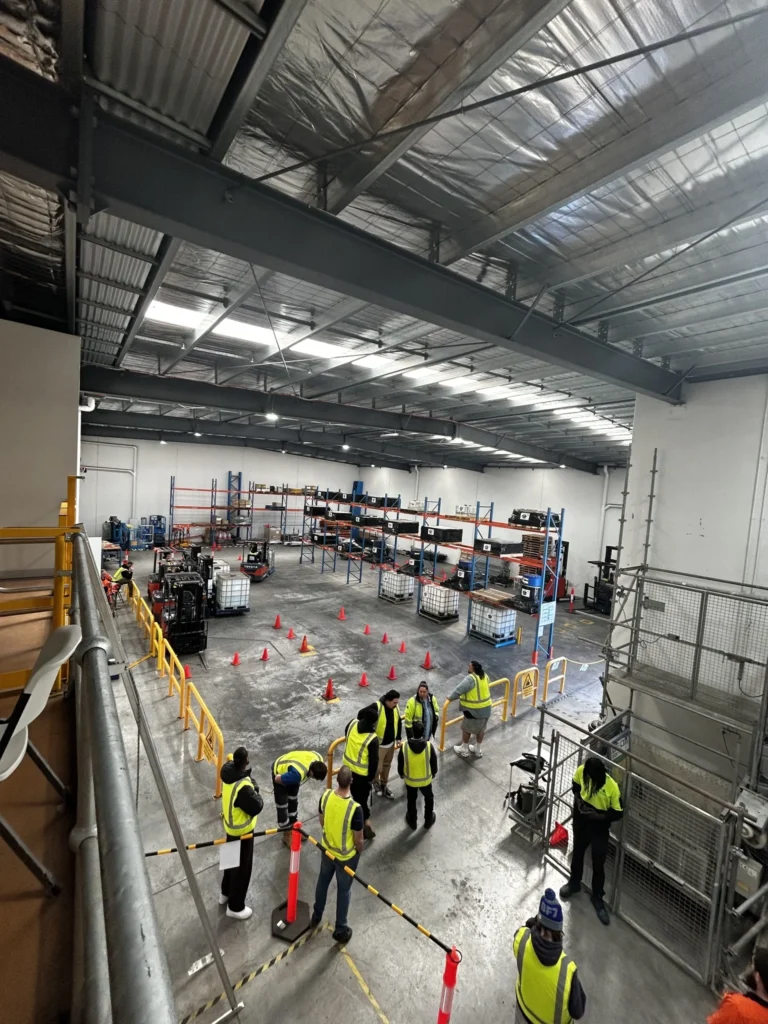
Industrial operations depend on surfaces that are strong, reliable, and built to withstand extreme demands. From high-traffic warehouse floors to heavy-duty loading docks, industrial concrete plays a central role in ensuring efficiency, safety, and long-term durability. When these surfaces are designed and installed correctly, they reduce maintenance costs, support heavier loads, and create safer working conditions for teams and equipment. But when poorly constructed, they quickly become the source of cracking, downtime, safety incidents, and expensive repairs.
This guide dives deep into the real world of warehouse concrete floors and loading dock construction—backed by proven engineering principles, industry standards, and firsthand experience from professionals who install and maintain industrial concrete every day.
Why Industrial Concrete Matters for Warehouses & Loading Docks
Warehouses and distribution centers experience some of the harshest operating conditions in the industrial environment. Forklifts, pallet jacks, 18-wheelers, and constant foot traffic all place immense stress on concrete surfaces. Concrete in these spaces isn’t simply “a floor”—it’s a critical structural element that must perform reliably under pressure.
Heavy Load Capacity & Structural Strength
Warehouse floors must support:
- Static loads from racking systems weighing tens of thousands of pounds
- Dynamic loads from forklifts and reach trucks (often exceeding 9,000+ lbs per axle)
- Point loads from narrow aisle equipment
- Heavy freight entering and exiting loading docks daily
According to the American Concrete Institute (ACI), industrial floors typically require 4,000–5,000 psi concrete to withstand these conditions. Floors in cold climates or high-moisture environments often require even higher specifications or specialized admixtures for freeze-thaw resistance.
“The key to long-lasting industrial concrete is not strength alone—it’s the balance between subgrade stability, reinforcement, and precise finishing methods.” — ACI 360R-10 Industrial Flooring Guide
Impact Resistance for High-Traffic Environments
Forklift tires, dropped pallets, steel equipment, and rapid movement create significant impact forces. That’s why industrial concrete floors require:
- Thicker slabs (typically 6–8 inches)
- Proper joint spacing to control cracking
- High-quality aggregates for abrasion resistance
- Hardeners or densifiers for surface strength
In fact, a polished or densified concrete floor can increase abrasion resistance by up to 40–50%, according to industry testing from the Concrete Polishing Council.
Minimizing Maintenance & Downtime
Businesses lose valuable operational time when floors crack, spall, or settle. A well-installed industrial concrete floor reduces:
- Surface dusting
- Cracking and joint failure
- Moisture intrusion
- Equipment vibration issues
This translates into lower lifetime costs and longer service life—often exceeding 30+ years with proper installation and maintenance.
Key Design Considerations for Warehouse Concrete Floors
Designing a warehouse floor is a technical process that requires aligning engineering calculations, load requirements, environmental conditions, and operational needs. Below are the essential considerations every facility owner or contractor should understand.
1. Subgrade Preparation & Soil Conditions
The strength of a warehouse floor begins long before the concrete pour. A weak or poorly compacted subgrade will cause differential settlement, cracking, and uneven surfaces—which are especially hazardous for forklifts.
Key steps include:
- Compacting the soil to 95%+ Proctor density
- Installing granular base material (usually 4–8 inches)
- Ensuring proper moisture barriers to prevent slab curling
- Conducting soil bearing tests prior to construction
Many issues seen in aging warehouse floors—such as rocking slabs and joint breakdown—are directly caused by inadequate soil preparation.
2. Slab Thickness & Reinforcement
Industrial concrete slabs are typically between 6–8 inches thick, depending on load requirements. High-traffic forklift zones or areas near loading docks may require thicker sections or specialized reinforcement.
Reinforcement options include:
- Rebar grids to control structural cracks
- Welded wire mesh (WWM) to reduce surface cracking
- Steel fibers to improve tensile resistance
- Synthetic fibers for added durability and surface strength
Many modern warehouses now prefer steel fiber–reinforced concrete (SFRC), thanks to its superior crack control and faster installation times.
3. Concrete Mix Design for Industrial Use
Industrial concrete must be formulated for strength, durability, and workability. Common specifications include:
- 4,000–5,000 psi+ strength
- Low water-cement ratio for minimized shrinkage
- Air entrainment for freeze-thaw protection
- Admixtures such as plasticizers, retarders, or accelerators
A well-designed mix ensures a denser, stronger, and more durable slab that can withstand decades of industrial activity.
4. Surface Finishing Options
The finish of a warehouse floor affects not just appearance, but performance:
| Finish Type | Benefits | Best Use Cases |
|---|---|---|
| Polished Concrete | Highly reflective, low maintenance, dust-free | Warehouses, distribution centers, manufacturing plants |
| Broom Finish | Improved traction, economical | Loading docks, exterior ramps |
| Densified Concrete | Increased surface hardness and abrasion resistance | High forklift traffic zones |
| Epoxy or Urethane Coatings | Chemical resistance, safety markings, smooth finish | Food processing, logistics, automotive facilities |
Design Considerations for Loading Docks
Loading docks are among the most punishing environments for concrete. Slabs must handle constant impact forces from trucks, trailers, and heavy cargo while maintaining perfect alignment with dock levelers and warehouse floors.
Heavier Structural Requirements
Concrete at loading docks often requires:
- 8–12 inch thick slabs depending on freight volume
- High-strength concrete (4,500–6,000 psi)
- Extra reinforcement near dock edges and levelers
- Joint designs that minimize edge spalling
Dock aprons also need enhanced impact resistance to handle the downward force of semi-trailers during loading and unloading.
Drainage & Freeze-Thaw Protection
Because loading docks experience outdoor conditions, freeze-thaw cycles can create expansion pressure that fractures concrete. Therefore:
- Slabs must be slightly sloped for drainage
- Air-entrained concrete is critical for cold climates
- Sealants or coatings protect against de-icing chemicals
Proper drainage and moisture control significantly extend the lifespan of dock concrete.
Common Issues in Industrial Concrete Floors & How to Prevent Them
Even the strongest industrial concrete can underperform when design, installation, or maintenance is overlooked. Knowing the most common issues helps facility owners reduce costly repairs and avoid operational disruptions.
1. Cracking & Joint Failure
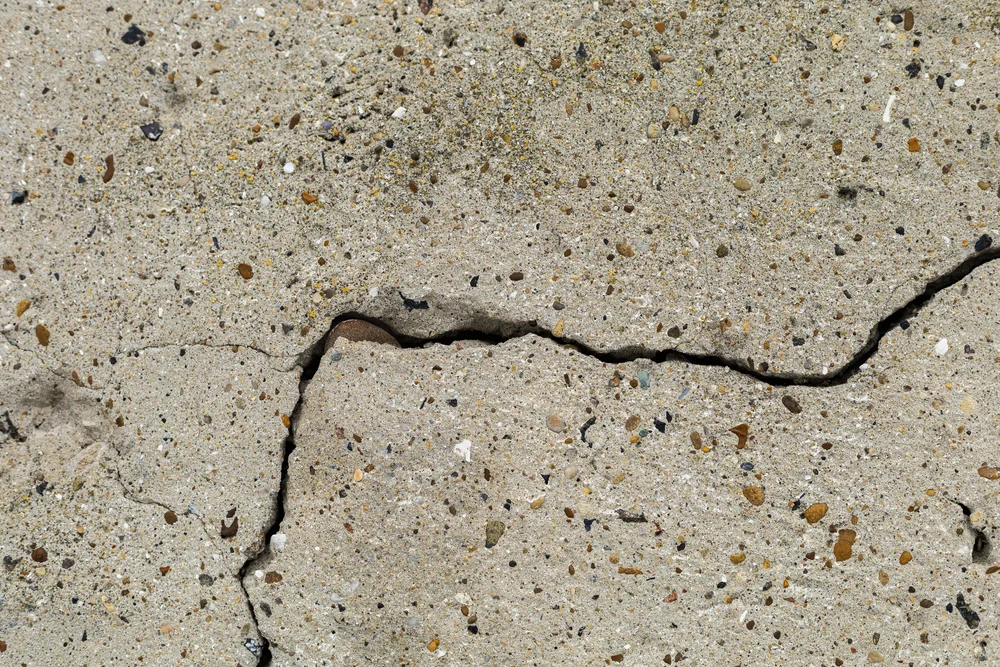
While some cracking is natural, excessive cracking or joint degradation can lead to:
- Equipment vibration and operator discomfort
- Damage to forklift wheels
- Safety hazards such as trip points
- Increased long-term maintenance costs
Causes: Poor subgrade compaction, incorrect joint spacing, heavy point loads, and moisture issues.
Prevention:
- Ensure proper reinforcement and joint placement
- Use high-quality concrete mixes with controlled shrinkage
- Install load transfer dowels at key locations
- Seal joints regularly to prevent moisture intrusion
2. Surface Dusting & Abrasion
Industrial floors experience heavy friction from forklifts, pallet movement, and rolling equipment. Weak surface layers can break down into dust, which impacts cleanliness and equipment lifespan.
Prevention includes:
- Densifying the concrete surface
- Using hardeners during installation
- Polishing to create a smooth, dense finish
According to the Concrete Polishing Council, densified floors can increase abrasion resistance by up to 50%, reducing dust and improving overall durability.
3. Moisture Problems
Moisture vapour transmission (MVT) can cause floor coatings to bubble, adhesives to fail, and slabs to curl. In loading docks, standing water accelerates freeze-thaw damage.
Prevention Measures:
- Use proper vapour barriers (minimum 10 mil)
- Ensure good drainage slopes at dock aprons
- Apply moisture-tolerant coatings when needed
- Maintain clean gutter and drainage systems
Maintenance Tips for Long-Lasting Industrial Concrete Floors
Like any critical infrastructure, industrial concrete floors require regular inspection and care. Proactive maintenance extends service life and prevents costly shutdowns.
1. Routine Cleaning & Dust Control
Keeping floors clean prevents buildup that can abrade the surface or cause slip hazards. Automated scrubbers are often recommended for large facilities.
2. Regular Joint Inspections
Joints are the most vulnerable part of any warehouse slab. Inspect them regularly for:
- Cracking
- Spalling (chipped edges)
- Separation or widening
- Deterioration of sealants
Prompt repair prevents damage from spreading into surrounding concrete.
3. Surface Resealing or Polishing
Depending on traffic, floors may need resealing every 1–3 years. Polished floors should be re-burnished or re-polished periodically to maintain reflectivity and abrasion resistance.
4. Addressing Problem Areas Early
Small cracks, settlement low spots, or early signs of joint wear should be repaired immediately. Delayed attention often results in larger structural failures requiring full slab replacement.
Industrial Concrete Installation Process
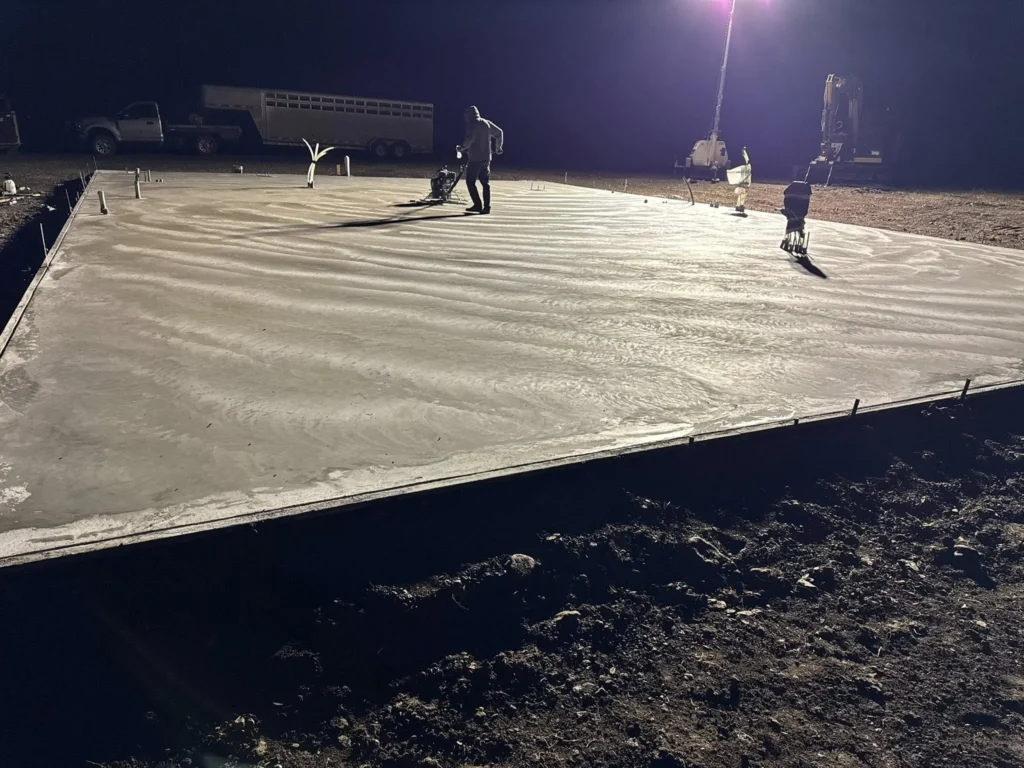
A successful warehouse or loading dock slab requires precision at every step—from excavation to curing. Below is a streamlined view of the typical installation workflow used by professional concrete contractors.
1. Site Assessment & Engineering
Engineers evaluate soil conditions, load requirements, moisture levels, and facility layout to determine slab thickness, reinforcement, and mix design.
2. Excavation & Subgrade Preparation
This includes clearing the site, leveling the area, compacting the soil, and installing a granular base layer. Proper compaction is essential for long-term slab stability.
3. Formwork, Reinforcement & Pour Planning
Forms are placed to create clean slab edges. Reinforcement (rebar, mesh, or fibers) is installed, and construction joints are pre-planned for shrinkage control.
4. Concrete Pouring & Leveling
Concrete is placed efficiently to maintain consistency, then leveled using tools like screeds and laser levels for accuracy.
5. Finishing, Hardening & Polishing
Depending on the floor’s use, contractors may:
- Apply densifiers
- Polish the surface
- Perform troweling for smooth finishes
- Add brooms textures for slip resistance outdoors
6. Curing & Final Inspection
Curing allows concrete to gain strength and prevents shrinkage cracking. A final inspection ensures the slab meets specification requirements before use.
Industrial Concrete Floor & Loading Dock Cost Breakdown
The total cost of an industrial concrete project varies based on size, thickness, reinforcement, finishing options, and site conditions. Below is an approximate comparison:
| Service Type | Average Cost (per sq ft) | Cost Factors |
|---|---|---|
| Warehouse Concrete Floor (Standard) | $7 – $12 | Slab thickness, reinforcement, joint design, curing |
| Warehouse Polished Concrete | $8 – $15 | Polish level, densifier, abrasion resistance |
| Loading Dock Slab | $12 – $20 | Thicker slab (8–12″), rebar, freeze-thaw protection |
| Dock Apron Repair or Replacement | $10 – $25 | Subgrade issues, joint repair, slope adjustments |
Note: Costs vary by region, material availability, weather conditions, and operational complexities.
Conclusion: Why Industrial-Grade Concrete Is Essential for Safe & Efficient Operations
Warehouse floors and loading docks are critical infrastructure components that directly influence productivity, safety, and long-term operational costs. Well-designed industrial concrete provides unmatched load capacity, durability, and performance—ensuring businesses can operate smoothly without interruptions.
Whether you’re building a new facility or upgrading an existing one, investing in high-quality industrial concrete installation is one of the smartest decisions you can make.
Need professional industrial concrete services? Our experienced team specializes in warehouse floors, loading docks, and heavy-duty industrial applications—built to last decades.
Contact us today for a free consultation and site assessment.
FAQs About Industrial Concrete Floors & Loading Docks
1. How thick should a warehouse concrete floor be?
Most warehouse floors range from 6–8 inches thick, depending on equipment loads, racking weight, and traffic levels.
2. How long does industrial concrete take to cure?
Initial cure: 24–48 hours.
Full structural cure: 28 days for optimal strength.
3. What is the best finish for warehouse floors?
Polished concrete is preferred for its durability, reflectivity, and low maintenance requirements.
4. Why do loading docks require thicker slabs?
Loading docks experience heavy impact forces from semi-trailers. Slabs typically range from 8–12 inches with high-strength reinforcement.
5. How do I prevent concrete cracking?
Proper joint placement, quality reinforcement, correct curing, and a stable subgrade are essential for long-term crack control.
