
Choosing between a poured concrete driveway or an interlocking paver patio in Calgary isn’t just about looks or price. It’s a long-term decision that affects how your property handles our notorious Chinook cycles and harsh winters. From the icy sidewalks of Inglewood to new builds in Springbank, homeowners and developers face this same dilemma every season.
So how do you cut through the noise and pick the right surface for your home, business, or development? Let’s dive into a complete, Calgary-focused comparison of concrete vs interlock, with clear pros, cons, and local considerations.
What Are Interlocking Pavers?
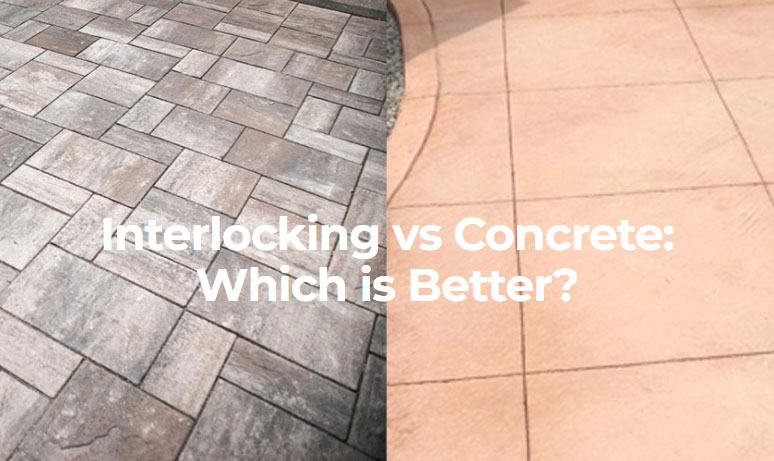
Interlocking pavers are individual, pre-cast concrete blocks manufactured to fit together tightly without mortar. They rely on precise shapes and a mechanically locked edge profile to create a unified surface over a prepared sand and gravel base. This system creates a flexible, grid-like mat that can handle ground movement.
They come in a vast array of colours, textures, and shapes—from classic rectangles to intricate fan patterns. For a project like a pathway along the Bow River pathways or a commercial entrance in the Beltline, this design flexibility is a major draw. The key is that each paver is a discrete unit, which fundamentally changes how the installation behaves over time.
What Is Concrete?
Concrete is a monolithic, poured-in-place surface. It’s a mixture of cement, aggregate (like gravel or crushed stone), sand, and water that’s poured into forms on-site and hardens into a single, continuous slab. Whether it’s a simple broom-finish driveway in McKenzie Towne or a stamped patio mimicking stone, it’s all one solid piece.
This continuity gives concrete its strength and seamless look, but it also means the entire slab reacts as one unit to stress. The quality of the pour, the mix design, and the finishing techniques—factors EdmontonConcrete services specializes in—directly determine its lifelong performance against Calgary’s freeze-thaw challenges.

Durability and Longevity
Both materials are durable, but they fail in different ways. In Calgary, durability isn’t just about strength; it’s about resilience to thermal expansion, ground heave, and de-icing salts.
Interlocking Pavers Durability
Interlock’s greatest strength is its fault tolerance. Because each paver moves independently, ground settlement or freeze-thaw heave rarely causes catastrophic failure. A sunken area in your Killarney driveway might cause a slight dip, but you can simply lift and re-level the affected pavers with fresh bedding sand.
The pavers themselves are incredibly dense and strong, often with a compressive strength exceeding that of poured concrete. However, the system’s weakness lies in its edges and joints. Without proper restraint, pavers can spread laterally over time, and joint sand can wash out, requiring periodic top-up.
The key takeaway: Interlock handles ground movement gracefully, but requires ongoing joint maintenance.
Concrete Cracking and Freeze-Thaw Resistance
Concrete’s monolithic nature is a double-edged sword. A properly engineered and poured slab is immensely strong and load-bearing, ideal for heavy traffic or commercial loading zones. However, any weakness—like improper curing, a poor base, or inadequate reinforcement—affects the entire slab.
In Calgary, the biggest threat is uncontrolled cracking from thermal stress. When water penetrates cracks and freezes, it expands, causing spalling (surface flaking) and widening the fault. High-quality concrete from a local expert like EdmontonConcrete, with proper air entrainment and reinforcement, is designed to minimise this, but cracking is always a risk.
Bottom line: Superior concrete can last decades, but its failure is often total and repair is invasive.
Cost Comparison
Cost is often the deciding factor, but it’s crucial to look beyond the initial invoice. A true comparison includes installation, long-term value, and the cost of ownership over 10-15 years in our climate.
Initial Installation Costs
Generally, interlocking pavers have a higher upfront cost per square foot. The precision manufacturing of the units, the more labour-intensive installation process involving precise cutting and placement, and the higher-quality granular base required all contribute to this. For a standard residential driveway, interlock can be 20-40% more expensive initially than poured concrete.
Concrete’s initial cost is lower because the material is less expensive and the installation process, while skilled, is faster for large, unbroken areas. However, costs rise quickly with decorative finishes like stamping, exposed aggregate, or colouring, which can bring it closer to paver pricing.
Long-Term Costs and Value
This is where the comparison shifts. Interlock’s maintenance is predictable and relatively low-cost: topping up joint sand and occasional releveling. Major repairs are piecemeal and cheap. Concrete maintenance is less frequent but far more expensive when needed. Sealing is required every few years, and crack repair or full section replacement is costly and disruptive.
Resale value can also differ. In many Calgary neighbourhoods like Aspen Woods, the high-end aesthetic and perceived durability of quality interlock can positively impact property value. Concrete’s value is more consistent but less likely to be a standout feature.
Budget Examples
Let’s put numbers to it. For a 500 sq ft driveway in Calgary:
- A basic broom-finish concrete slab might range from $5,500 to $7,500 installed.
- A standard interlock paver installation for the same area typically starts around $8,000 and can go to $12,000 depending on pattern complexity.
- A decorative stamped concrete driveway, however, could land in the $9,000 to $11,000 range, blurring the cost difference.
The smart approach is to budget for the *total* cost over 15 years, not just the day-one price.
Which offers better long-term value? It depends entirely on how you weigh upfront investment against future repair bills.
Installation Process and Timeline
How these surfaces get installed affects your project schedule, disruption, and the final outcome’s quality.

Interlocking Pavers Installation Methods
A proper interlock installation is a multi-layer, engineered system. It starts with excavation and a compacted subgrade, followed by a gravel base layer, a bedding sand layer, the pavers themselves, and finally joint sand and edge restraint.
Mechanical Interlock
This refers to the physical shape of the paver edges (like knobs and grooves) that lock together horizontally, preventing individual units from shifting. It’s a feature of the paver design itself and is critical for maintaining surface integrity without mortar.
Structural Interlock
This is the system-wide stability achieved by combining mechanical interlock with proper edge restraint (like concrete curbs or spike-down plastic borders) and a well-compacted base. Structural interlock ensures the entire paved area acts as a unified, flexible mat that resists spreading.
A proper interlock installation is a slower, meticulous process, but it’s the foundation of its long-term performance.
Concrete Installation
Concrete installation is a faster, more intense process. After site prep and forming, the concrete is mixed, poured, compacted, finished (broomed, stamped, etc.), and then must cure undisturbed for days. The timeline is heavily weather-dependent; rain or sudden cold during curing can ruin the slab.
The entire process for a driveway might be completed in 2-3 days, with curing taking up to a week before it can be driven on. The speed is an advantage, but the “all-at-once” nature means there’s no room for error during the pour.
Aesthetics and Design Flexibility
Your choice here will define the look of your property for years. Both offer options, but in fundamentally different ways.
Interlocking Pavers Styles and Patterns
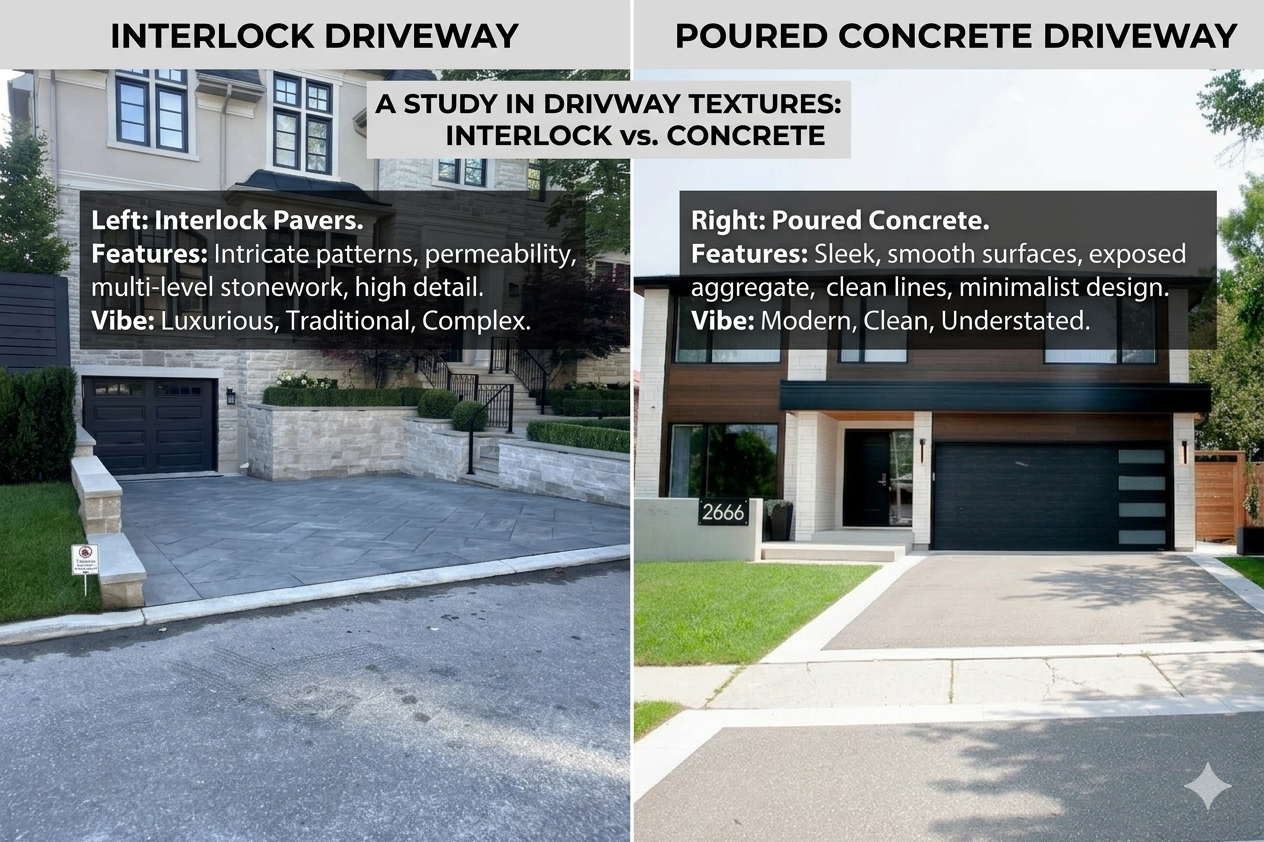
Interlock wins in sheer variety. You can choose from dozens of colours, multiple textures (tumbled, smooth, slate-faced), and countless patterns (herringbone, basket weave, circular fans). This allows for intricate designs, borders, and inlays that poured concrete cannot replicate. It’s ideal for creating a custom, high-end look in communities like Britannia.
The ability to mix colours within the same pattern also adds a level of customization that is simply not possible with monolithic concrete.
Concrete Finishes and Limitations
Concrete aesthetics come from its finish. The most common is a simple broom finish for traction. For decoration, stamping can imitate stone, brick, or wood, and exposed aggregate reveals a colourful stone surface. Integral colouring can tint the entire slab.
The limitation is that these are *surface treatments* on a single slab. You cannot create different “pieces” or intricate patterns that break the monolithic plane. The design is more about texture and colour uniformity than individual unit arrangement.
For unlimited pattern and colour mixing, choose interlock. For large-scale, uniform texture and colour, concrete offers beautiful options.
Maintenance and Repairs
Think of maintenance not as a chore, but as a cost and time investment over the life of your surface.
Interlocking Pavers Maintenance
Maintenance is regular but simple. The primary task is replenishing the polymeric joint sand every few years as it washes out or degrades. This prevents weed growth and keeps pavers locked. Occasional power washing keeps them clean.
Repairs are incredibly easy. If a paver stains, cracks, or a section sinks, you can replace individual units or relevel a small area without touching the rest of the installation. This localized repair is a huge advantage.
Concrete Maintenance Challenges
Concrete requires less frequent but more involved maintenance. A quality sealant must be reapplied every 2-3 years to protect against stains, salt, and water penetration. Without sealing, the surface degrades faster.
Repairs are difficult. Cracks must be filled with specialized compounds, and spalled sections require grinding or patching, which rarely matches the original finish. Major damage often means removing and replacing entire sections, which is costly and messy.
Environmental Impact and Drainage
With increasing focus on sustainable landscaping and Calgary’s drainage bylaws, environmental performance matters.
Permeability and Runoff
Traditional poured concrete is virtually impermeable, directing all rainwater into storm drains or onto adjacent soil. Interlock systems, when installed with open-graded gravel bases and porous joint sand, can be highly permeable, allowing water to infiltrate the ground below. This reduces runoff and can help with natural drainage on sloped properties like those in Crestmont.
Permeable interlock systems are a significant advantage for managing surface water naturally and are often encouraged in new community developments.
Heat Island Effect
Both materials contribute to the urban heat island effect by absorbing and retaining solar heat. However, lighter-coloured concrete can reflect more heat than dark pavers. Some interlock manufacturers now offer lighter, heat-reflective colours to mitigate this.
For eco-conscious projects aiming to reduce runoff, permeable interlock is the clear winner.
| Factor | Interlocking Pavers | Concrete |
|---|---|---|
| Cost | Higher initial cost, predictable low long-term maintenance | Lower initial cost, potentially high long-term repair costs |
| Durability | High fault tolerance; handles ground movement well | High monolithic strength; vulnerable to uncontrolled cracking |
| Best For | High-design residential projects, permeable surfaces, areas with ground instability | Large commercial areas, high-load applications, uniform aesthetic projects |
| Calgary Climate Suitability | Excellent; flexible system handles freeze-thaw cycle well | Good with proper engineering; requires high-quality mix and installation |
| Maintenance Required | Regular joint sand replenishment, easy localized repairs | Periodic sealing, difficult and costly crack/spall repairs |
Which Is Right for You?
The table gives you the data, but your specific project needs, location, and budget will point you to the right choice.
Choose Interlocking Pavers If…
You prioritize design flexibility and a high-end aesthetic for your home in a neighbourhood like Mount Royal. You want a surface that can handle Calgary’s ground heave with minimal drama and prefer manageable, DIY-friendly maintenance. Your project also benefits from permeable drainage, and you’re comfortable with a higher initial investment for long-term piecemeal repair costs.
Choose Concrete If…
You need a cost-effective, strong surface for a large area like a commercial parking lot or a simple, clean-lined driveway. You value a faster installation timeline and a uniform look. You are committed to periodic professional sealing and understand that any major repair will be a significant undertaking. For a reliable, traditional surface installed by experts like EdmontonConcrete, concrete remains a superb choice.
Regional Considerations (e.g., Winters and Salt)
Calgary isn’t just cold; it’s a climate of extreme swings, clay soil, and specific bylaws. Here’s what that means for your choice.
Our freeze-thaw cycles are the ultimate test. Interlock’s flexibility is a natural advantage here, as the ground movement under your Silver Springs home is absorbed by the system. Concrete must be specifically designed for it—with proper air entrainment (tiny bubbles that give water expansion room) and a well-drained base—to survive.
De-icing salt is brutal on both surfaces, but affects them differently. Salt can accelerate spalling on concrete if it penetrates cracks. For interlock, salt can degrade the polymeric joint sand over time, requiring more frequent top-ups. Using less corrosive alternatives like calcium chloride can benefit both.
For Calgary’s climate, interlock’s inherent flexibility often gives it a resilience edge, but premium concrete, properly engineered, is a formidable competitor.
FAQ
Can interlock pavers heave in Calgary winters?
Individual pavers can shift slightly, but the entire system is designed to accommodate this movement without cracking. The real issue is improper installation without adequate edge restraint, which can allow the whole paved area to spread. A professionally installed system on a proper base handles Calgary heave very well.
If a section does sink due to base washout, repair is straightforward: lift the pavers, re-level the base sand, and replace them.
Is stamped concrete more expensive than interlock?
It can be comparable. While basic concrete is cheaper, complex stamped and coloured concrete finishes involve significant labour and material costs. For a mid-range project, a stamped concrete driveway and a standard interlock driveway can fall into a similar price range, around $18-$25 per square foot in Calgary.
The decision then comes down to your preference for a monolithic patterned surface versus a unit-based pattern.
Which is better for a driveway on Calgary’s clay soil?
Clay soil expands when wet and contracts when dry, causing ground movement. Interlock’s flexible, jointed system is typically better suited for this unstable base condition as it moves with the soil. Concrete on clay soil requires a much more robust, deeply compacted gravel base to isolate the slab from the clay’s movement, adding to the cost.
In older communities with mature clay soils, many local contractors recommend interlock for its fault tolerance.
How long does each material last in our climate?
With proper installation and maintenance, both can last 25+ years. The lifespan story is different, however. Interlock might require minor upkeep throughout its life but maintains its appearance and function. Concrete may require little maintenance for 15 years, then potentially need significant rehabilitation or partial replacement.
A well-installed interlock system in Calgary often has a more predictable and consistent longevity.
Our Verdict
There’s no universal winner. For Calgary homeowners seeking design flair, permeability, and resilience to ground movement, interlocking pavers are an excellent, albeit pricier, investment. Their ease of repair aligns perfectly with our climate’s challenges.
For large-scale, cost-conscious projects where a uniform, strong surface is key—and where a premium, expertly engineered concrete mix is used—poured concrete remains a trusted and durable solution. The choice hinges on your budget, aesthetic goals, and tolerance for future maintenance.
Ready to make a confident decision for your Calgary property? Discuss your specific site, soil, and style with a local expert who understands both options deeply. EdmontonConcrete can provide detailed quotes and recommendations for your concrete or interlock project, ensuring it performs beautifully for decades against our unique Alberta elements.
